'/%3e%3cpath%20d='M84%20126C60.804%20126%2042%20107.196%2042%2084C42%2060.804%2060.8041%2042%2084%2042L84%20126Z'%20fill='%235546FA'/%3e%3c/svg%3e)
KOL vs KOC: Which Influencer Strategy Wins in China?
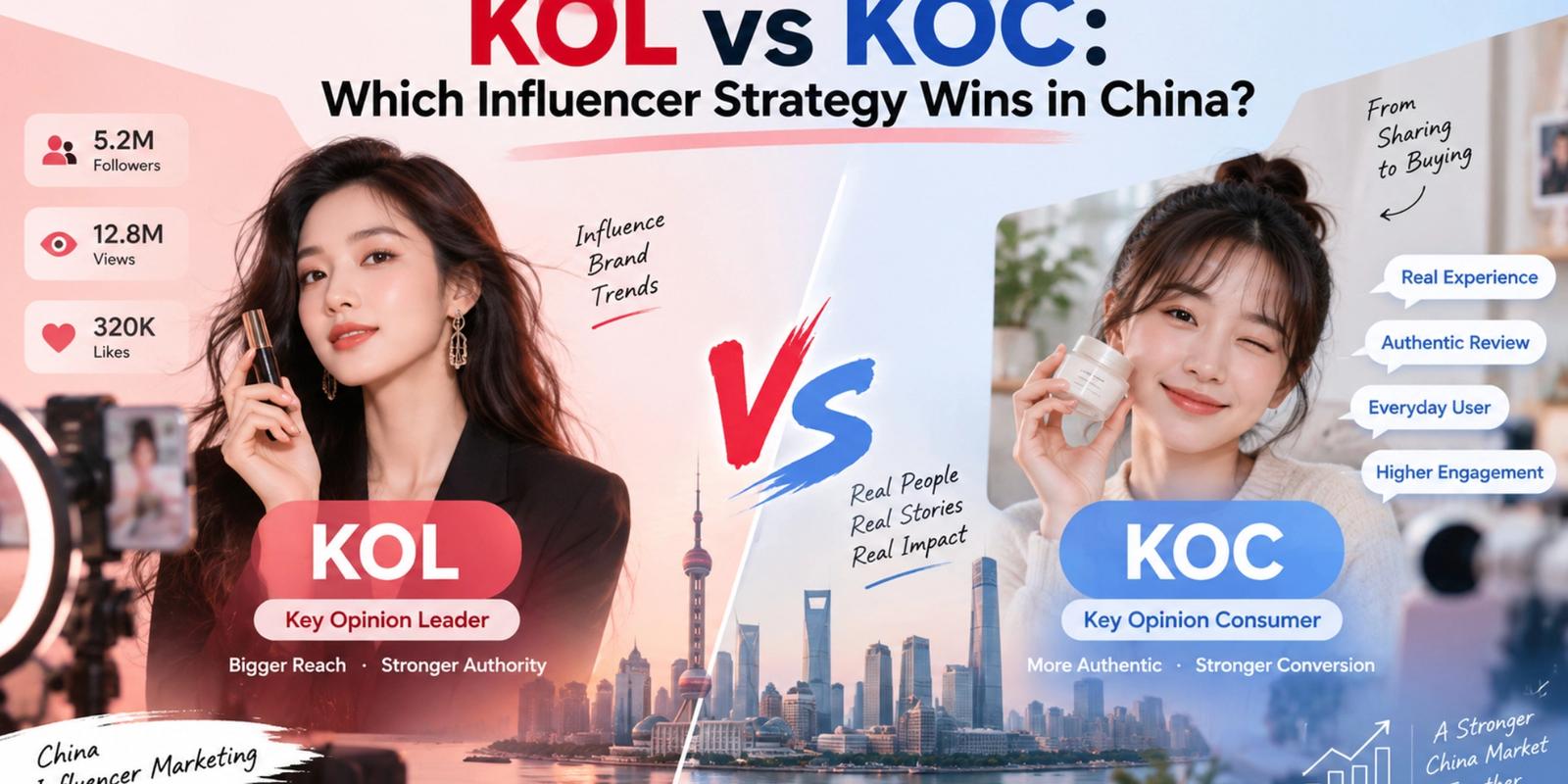
For KOL vs KOC marketing in China, neither creator type wins in every situation. KOLs are generally stronger for reach and authority, while KOCs can provide relatable recommendations, niche coverage, and consumer-level social proof. The strongest strategy often combines both.
China's creator economy gives international brands enormous potential reach. By December 2025, China had 1.074 billion short-video users, representing 95.4% of the country's internet users, according to data published by the China Netcasting Services Association (CNSA). Short-video users grew 3.27% year over year after declining slightly in 2024.
However, audience size alone does not guarantee influencer ROI.
For foreign brands entering China in 2026, the more important question is how to match creators with specific objectives: brand awareness, consideration, search visibility, product education, conversion, or advocacy.
A major KOL can expose a product to millions of consumers quickly. A network of smaller KOCs may reach fewer people individually but create multiple reviews, comparisons, tutorials, and real-life product experiences.
An effective influencer marketing strategy in China therefore often uses several creator tiers rather than treating KOL and KOC marketing as an either-or decision.
What Are KOLs, KOCs, and Nano-Influencers?
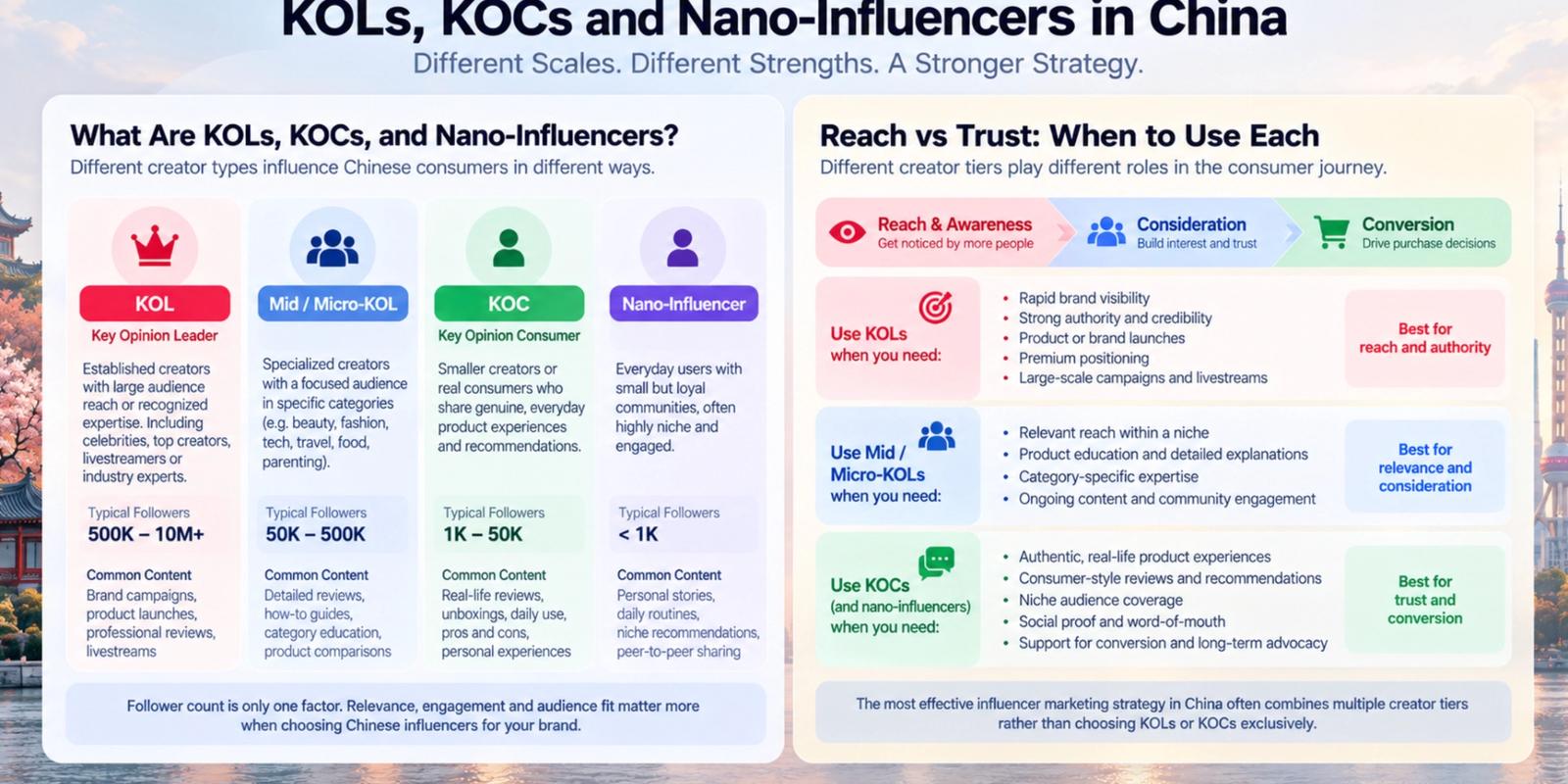
KOLs are established creators with significant audience reach or recognized expertise, while KOCs are smaller creators or consumers whose influence tends to come from relatability and everyday product experience.
A KOL (Key Opinion Leader) may be a celebrity, professional content creator, livestreamer, industry expert, or vertical specialist in beauty, fashion, gaming, technology, travel, food, finance, parenting, or another category.
A KOC (Key Opinion Consumer) typically operates at a smaller scale. Their content may resemble consumer recommendations, including reviews, comparisons, unboxings, tutorials, routines, and personal experiences.
A nano-influencer generally refers to a creator with a particularly small community. However, there is no single official follower threshold in China that universally separates nano-influencers, KOCs, micro-KOLs, and larger KOLs.
Creator Type
Main Strength
Typical Role
Top KOL
Scale and visibility
Launches, awareness
Mid/micro-KOL
Relevance + reach
Education, consideration
KOC
Relatability
Reviews, product seeding
Nano creator
Niche community
Testing, peer advocacy
When choosing Chinese influencers for a brand, the key question should not simply be “How many followers do they have?” but “Do they influence the consumers we actually need to reach?”
Reach vs Trust: When to Use Each
Use KOLs when rapid visibility and authority matter most; use KOCs when the campaign needs more consumer-style experiences, niche coverage, and multiple points of social proof.
Different creator tiers should perform different jobs within the same campaign.
KOLs for Brand Awareness Campaigns
KOLs are particularly useful when brands need to establish awareness quickly or attach a recognizable voice to a new product.
Typical uses include:
- Brand and product launches
- Premium or luxury positioning
- Major promotional campaigns
- Livestream launches
- Brand storytelling
- Product or category education
For example, a respected skincare KOL can explain a foreign beauty product's ingredients, positioning, and hero benefits to a large relevant audience much faster than dozens of individual consumer posts.
But brands should evaluate relevant reach, not headline follower numbers.
Before committing budget, review audience demographics, recent average views, engagement patterns, content-category fit, sponsored-post frequency, previous brand partnerships, and the quality of comments around commercial content.
KOCs for Conversion and Authenticity
KOCs become especially useful when consumers want to see what a product is like in real life before deciding whether to research or purchase it.
Typical KOC content addresses questions such as:
- Is it worth buying?
- Does it actually work?
- What does it look like in real life?
- Which version should I choose?
- How does it compare with alternatives?
This behavior is particularly relevant on Xiaohongshu (RED). The platform has more than 300 million monthly active users. According to Economic Information Daily, approximately 200 million users per month seek purchasing advice on Xiaohongshu, while users open the app around 16 times per day.
That makes creator content useful beyond initial exposure: reviews can become part of the information consumers encounter when they later search and compare products.
Platform Breakdown: RED, Douyin, WeChat, Bilibili
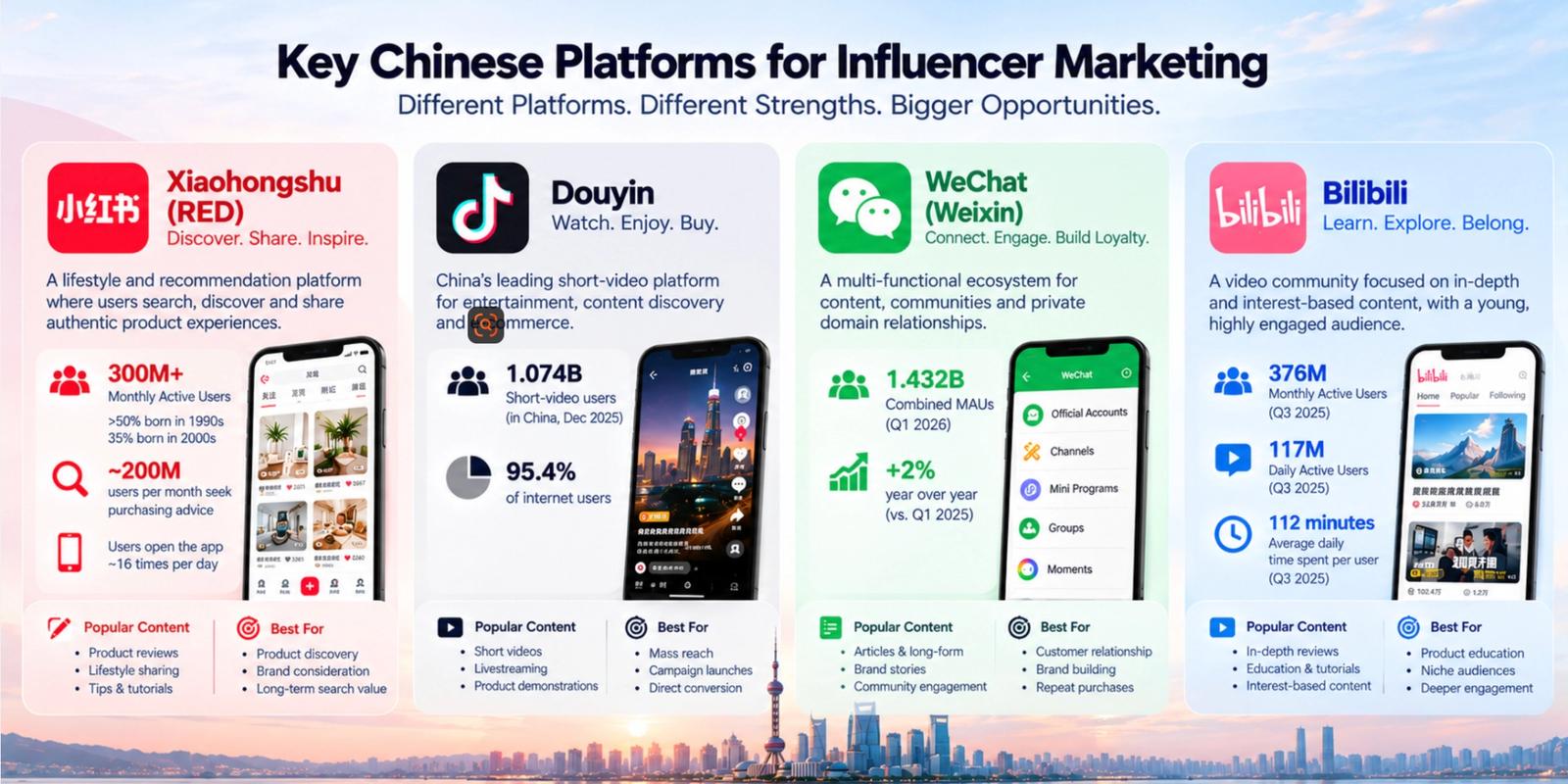
Choose platforms according to consumer behavior: Xiaohongshu for discovery and consideration, Douyin for short-video scale and commerce, WeChat for relationship-building, and Bilibili for deeper interest-based content.
Xiaohongshu (RED)
For a Xiaohongshu KOL campaign, a single influencer post is rarely the entire strategy.
A practical model is:
KOL awareness → mid-tier creator education → KOC reviews → amplify proven content
This approach suits Xiaohongshu's combination of feed discovery, search, recommendations, and consumer research.
Xiaohongshu's emphasis on more human and emotionally relevant marketing. Xiaohongshu's commercial FMCG team discussed how some consumer needs are moving beyond functional benefits toward emotional value, encouraging brands to build stronger lifestyle and emotional connections.
Douyin
Douyin is particularly effective when product benefits can be demonstrated quickly and visually.
China's 1.074 billion short-video users illustrate the scale of the broader short-form video environment. Large creators can generate rapid awareness, while smaller creators can test different hooks, demonstrations, use cases, and calls to action.
For commerce campaigns, creator activity can also connect with livestreaming, product pages, and paid amplification.
WeChat plays a different role. Brands can connect influencer content with Official Accounts, Channels, communities, Mini Programs, and private-domain customer relationships.
Tencent reported 1.432 billion combined MAUs for Weixin and WeChat as of March 31, 2026, up 2% year over year from 1.402 billion.
For B2B, education, professional services, premium products, and high-consideration purchases, a credible niche creator may sometimes be more valuable than mass reach.
Bilibili
Bilibili now covers a much broader range of interests than its early gaming and anime associations, including technology, education, lifestyle, entertainment, automotive, and consumer products.
In Q3 2025, Bilibili reported 376 million MAUs, 117 million DAUs, and 112 minutes of average daily time spent per user. All three reached record highs for the platform.
This engagement makes Bilibili particularly relevant when creators need time to explain, review, compare, or demonstrate products.
Budget Allocation: Blending KOL and KOC Tiers
Rather than putting an entire campaign budget into one major KOL, build a portfolio of creator tiers and reserve budget to amplify content that performs.
There is no universal KOL/KOC budget ratio. However, foreign brands can use this as an initial planning framework rather than an industry benchmark:
Budget Area
Starting Share
Purpose
Top/mid-tier KOLs
30–40%
Awareness and authority
Micro-KOLs/KOCs
30–40%
Reviews and niche coverage
Paid amplification
15–25%
Scale effective content
Testing
10–15%
Test creators and formats
The final allocation should depend on category, average selling price, platform, brand awareness, campaign objective, and content-production requirements.
The important principle is to test before scaling. Instead of assuming the most expensive creator will produce the strongest results, identify the creator-content combinations that generate meaningful engagement, searches, leads, or sales and increase investment accordingly.
Case Study Examples by Industry
The right KOL/KOC mix depends on how much authority, explanation, demonstration, and peer validation consumers need before purchasing.
Beauty & skincare: Use established beauty KOLs to communicate ingredients, positioning, and hero benefits, while micro-creators and KOCs demonstrate textures, routines, skin types, and everyday usage. Xiaohongshu is especially useful for building searchable product discussions.
Food & beverage: Combine food or lifestyle KOLs with smaller creators showing consumption occasions, recipes, cafés, gatherings, or everyday experiences.
Technology: Specialist KOLs can establish technical authority, while smaller creators test specific scenarios such as gaming, battery life, productivity, photography, or product comparisons.
Travel & hospitality: Large travel creators can build destination awareness, while local KOCs contribute practical itineraries, restaurant recommendations, hotel experiences, and neighborhood tips.
Luxury: Prioritize creator fit, visual quality, audience relevance, brand safety, and exclusivity. Large-scale seeding is not necessarily appropriate if it weakens premium positioning.
How to Vet and Contract Chinese Influencers Safely
When choosing Chinese influencers, focus on audience fit, content quality, genuine engagement, past brand partnerships, and overall brand safety—not follower count alone.
Before working with a KOL or KOC, brands should review their audience profile, recent content performance, engagement quality, category relevance, and previous sponsored campaigns.
Agreements should clearly define key campaign requirements such as deliverables, publishing dates, content approval, usage rights, payment terms, and reporting.
For livestreaming or regulated industries, brands should also ensure campaigns follow relevant Chinese advertising and platform requirements. China's livestream e-commerce regulations, effective from February 2026, further strengthen requirements around truthful promotion, consumer protection, and platform responsibilities.
For regulated categories, professional legal or compliance advice may be appropriate.
Which Strategy Wins: KOL or KOC?
The strongest KOL vs KOC marketing China strategy typically uses KOLs to create attention and authority, then smaller creators and KOCs to add relevant consumer experiences, repeated touchpoints, and social proof.
Today, influencer marketing is better approached as a creator portfolio strategy than a search for one superstar.
Start with the business objective. Select platforms based on consumer behavior. Build a tiered creator matrix. Test messages and formats. Measure qualified engagement, branded search, leads, sales, or other relevant outcomes. Then scale the creators and content that demonstrate results.
For foreign brands choosing Chinese influencers, this provides more flexibility and risk diversification than betting a campaign on follower numbers alone.
China Digital Dynamics helps international brands develop China influencer strategies covering platform selection, KOL and KOC research, creator vetting, localization, campaign planning, content coordination, and performance evaluation.
The goal is not to find the biggest influencer. It is to build the right combination of people, platforms, content, and measurable influence for the customers a brand wants to reach.