'/%3e%3cpath%20d='M84%20126C60.804%20126%2042%20107.196%2042%2084C42%2060.804%2060.8041%2042%2084%2042L84%20126Z'%20fill='%235546FA'/%3e%3c/svg%3e)
Influencer Marketing in China
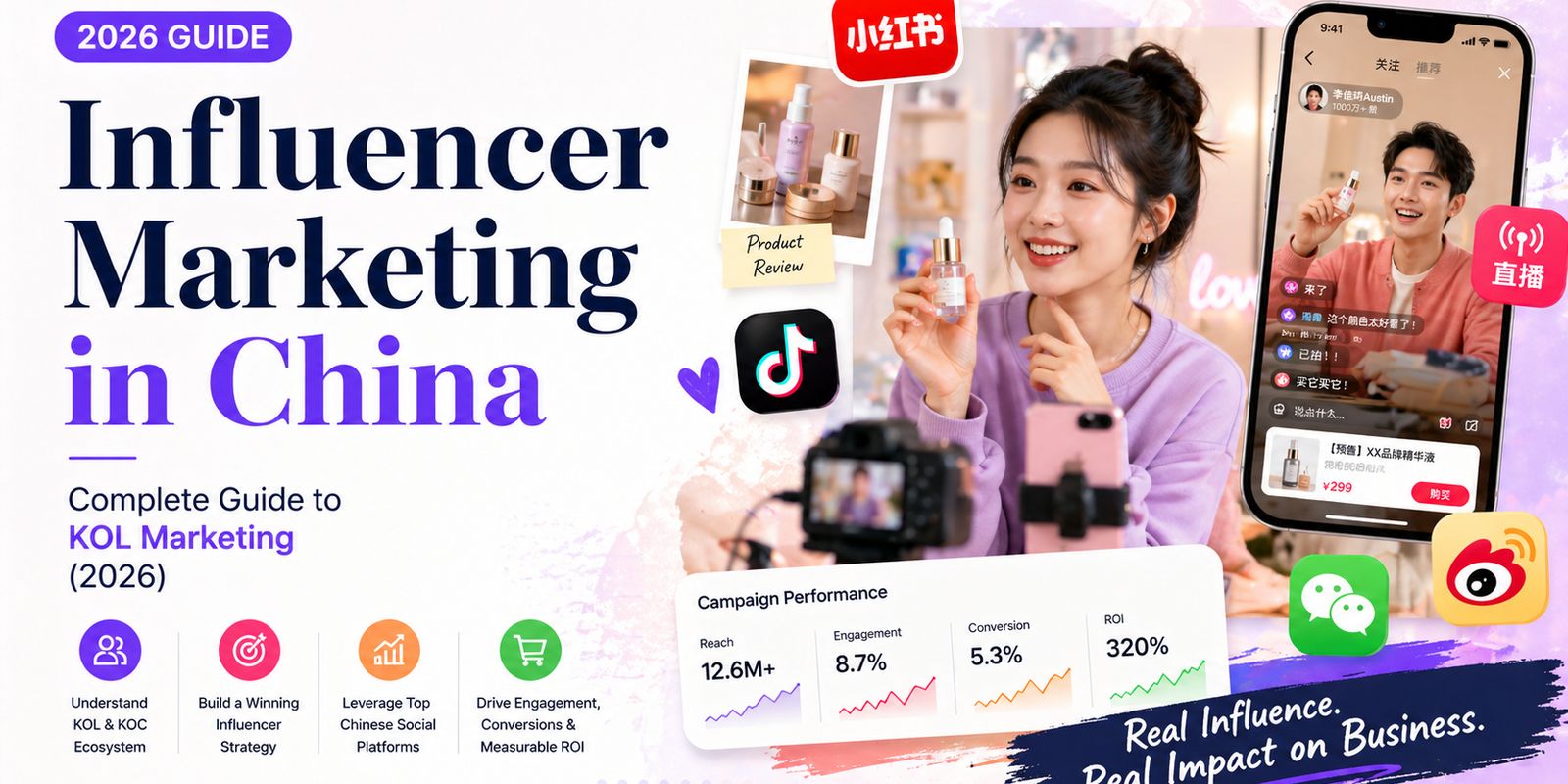
Influencer Marketing in China: Complete Guide to KOL Marketing (2026)
In China, influence is not just about visibility it is a direct driver of commerce. Influencer marketing in China operates much closer to the point of purchase than in Western markets, where it is often limited to awareness. Content, trust, and conversion are tightly integrated into a single user journey.
China’s influencer economy continues to scale rapidly. Research shows the market reached RMB 1.38 trillion in 2024, maintaining double-digit year-on-year growth. This expansion is driven by short-video platforms, livestream e-commerce integration, and the growing monetization efficiency of vertical influencers. This growth is driven by:
- The maturity of short-video traffic ecosystems
- Deep integration of livestream e-commerce with offline industries
- Improved monetization efficiency of niche (vertical) influencers
Beauty, fashion, and home goods remain core revenue categories, while lower-tier cities and the “silver economy” are emerging growth segments. At the same time, AI-powered content tools are reducing production costs by 30–50%, accelerating the expansion of mid- and long-tail creators.
What Is Influencer Marketing in China?
Influencer marketing in China revolves around KOLs (Key Opinion Leaders) and KOCs (Key Opinion Consumers) operating across social commerce ecosystems such as Douyin and Xiaohongshu.
What Are KOLs (Key Opinion Leaders)?
A key opinion leader in China is more than an influencer they function as a hybrid of media channel and sales platform. On platforms like Douyin and Xiaohongshu, KOLs combine content creation, product recommendations, and direct sales via livestreams and embedded purchase links.
KOL Marketing
KOC marketing refers to everyday users sharing authentic product experiences. These creators typically have smaller audiences but generate higher trust and relatability.
What Is KOC Marketing?
KOC marketing refers to everyday users sharing authentic product experiences. These creators typically have smaller audiences but generate stronger trust and relatability.
Difference Between KOL and KOC Marketing
- KOLs → Awareness and traffic generation
- KOCs → Trust building and validation
Effective KOL marketing strategies often follow a layered funnel:
KOL exposure → KOC validation → search-driven conversion
Why Influencer Marketing in China Is Important
Huge Social Media Influence in China
According to China Internet Network Information Center (CNNIC), China had 1.125 billion internet users by the end of 2025, with mobile internet MAUs reaching 1.267 billion. Short-video platforms reached 1.068 billion users, and micro-drama audiences grew to 626 million.
E-commerce activity continues to surge, particularly during major shopping festivals. Generative AI is also reshaping content creation, significantly improving efficiency and output.
Dominant Short-Video Platforms
- Douyin: 700M+ daily active users
- Xiaohongshu: 300M+ monthly active users
Trust-Based Buying Behavior
Consumer journeys in China are rarely linear. A typical path includes:
- Discovery via KOL content
- Validation through multiple KOC reviews (often on Xiaohongshu)
- Purchase decision
High Conversion Rates from KOL Marketing
China’s marketing funnel is highly compressed. Content is directly linked to conversion through embedded links and livestream shopping.
Livestream e-commerce continues to grow rapidly. In 2025:
- Online retail sales of physical goods reached 13.09 trillion yuan
- Livestream e-commerce GMV exceeded 5 trillion yuan
- Users in the sector are expected to reach 660 million
Content in China does not just inform it converts.
How Influencer Marketing in China Works
Role of KOLs in Chinese Marketing
KOLs are most effective when used strategically to launch products, amplify campaigns, or generate rapid awareness spikes.
Role of KOCs in Influencer Strategy
KOCs provide long-tail credibility. Their content ensures consistent, authentic validation across search and social platforms.
Platforms Used for KOL Marketing in China
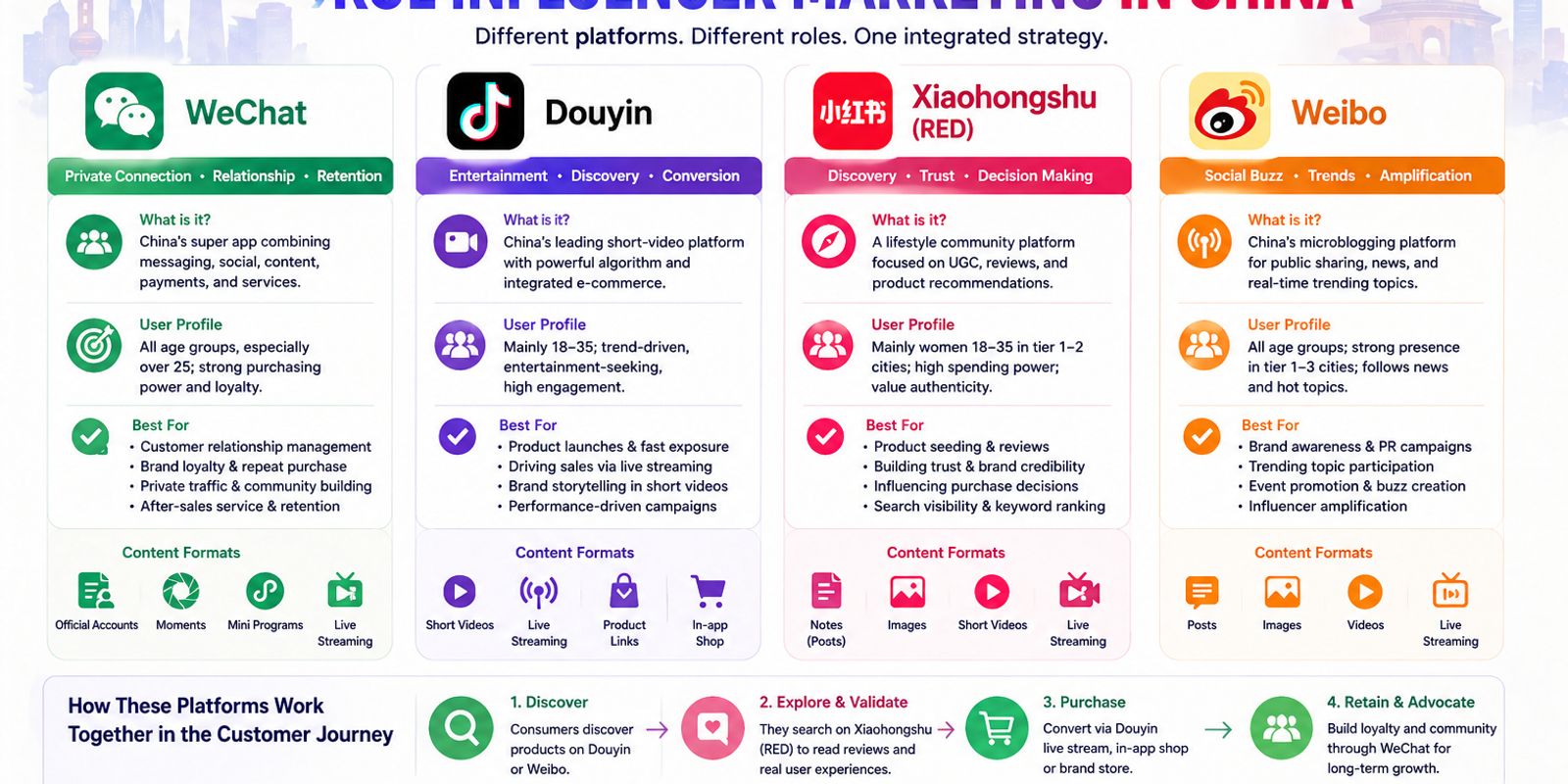
Each platform plays a distinct role:
- Douyin → Conversion-driven short video and livestream commerce
- Xiaohongshu (RED) → Discovery, reviews, and trust building
- WeChat → Retention and private traffic management
- Weibo → Mass awareness and campaign amplification
There is no single dominant platform successful strategies are always multi-platform.
Types of Influencers in China
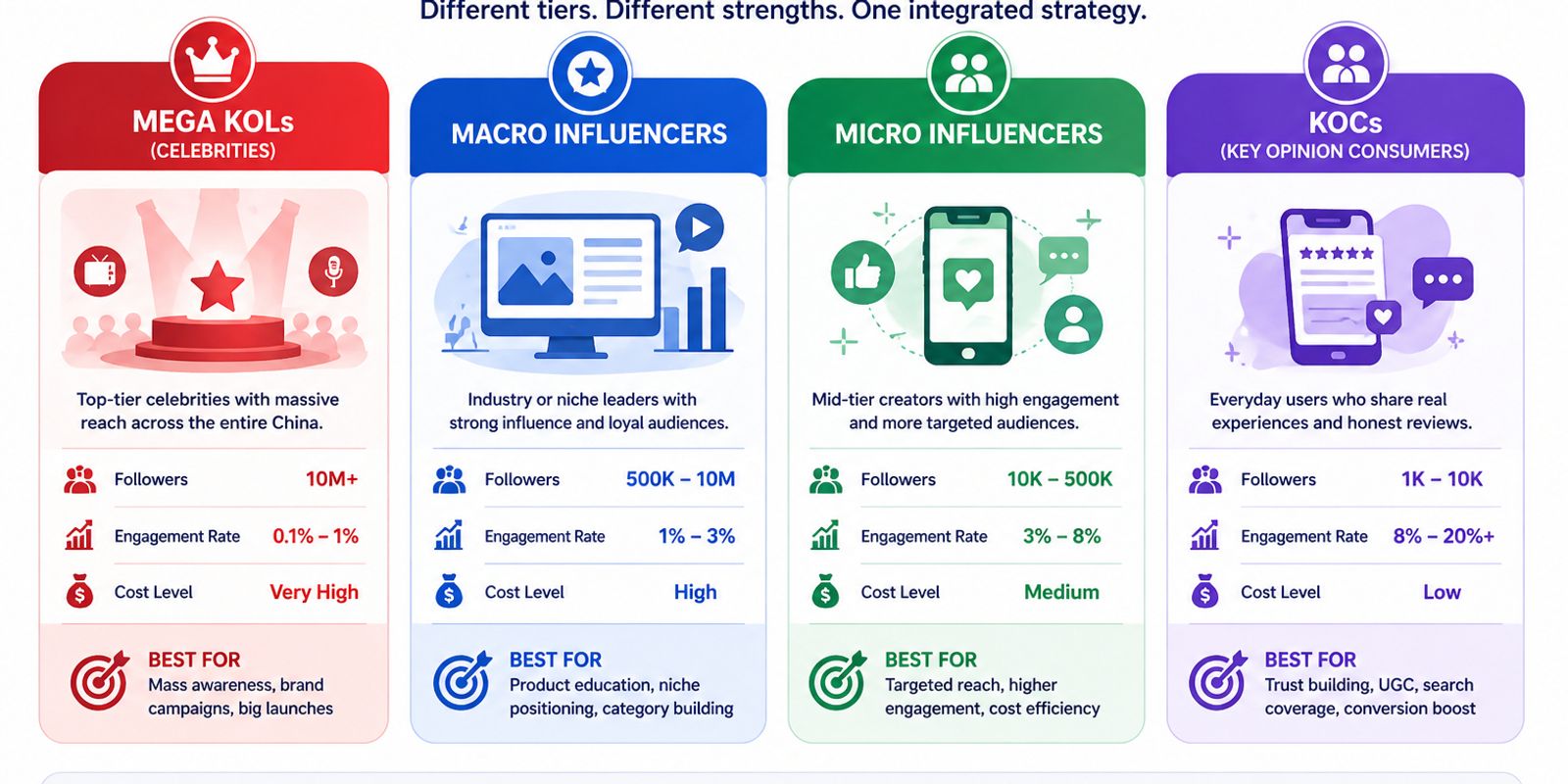
Mega KOLs (Celebrities)
Best for:
- Brand campaigns
- Mass awareness
Risk: high cost, low precision
Macro Influencers
Best for:
- Category authority
- Product education
Micro Influencers
Best for:
- Niche targeting
- Higher engagement
KOCs (Key Opinion Consumers)
Best for:
- Trust building
- Search coverage
In many cases, performance is driven not by scale, but by relevance smaller influencers frequently outperform larger ones in ROI.
How to Build a KOL Marketing Strategy in China
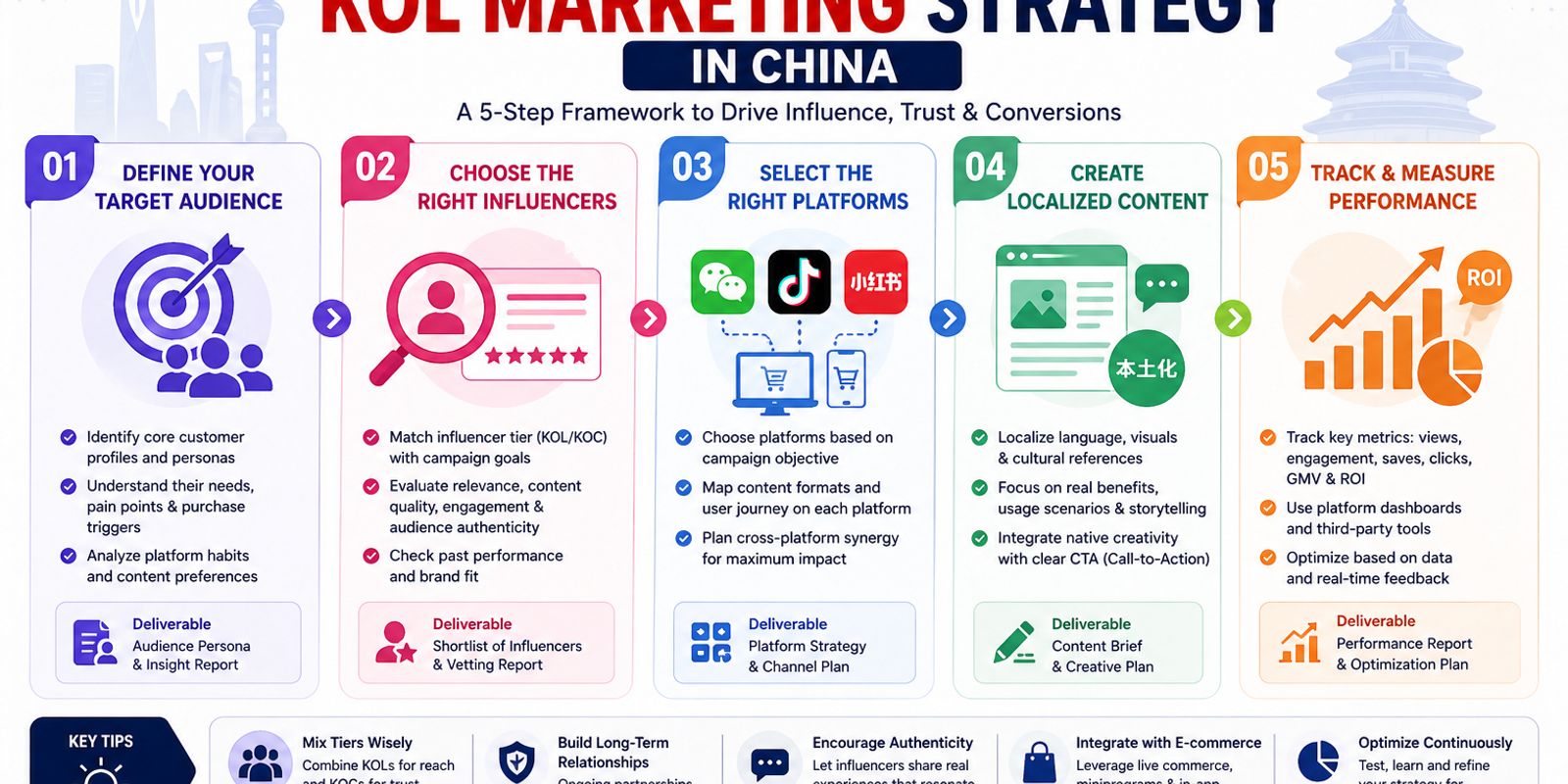
Step 1: Define Your Target Audience
Go beyond demographics—define:
- Platform behavior (Douyin vs RED users behave differently)
- Purchase triggers (price vs quality vs trend)
Step 2: Choose the Right Influencers
Don’t just check followers. Evaluate:
- Engagement rate (comments > likes)
- Audience authenticity
- Content style fit
Red flag: high followers + low comments = weak influence
Step 3: Select the Right Platforms
- New brand → Xiaohongshu first
- Conversion-driven → Douyin
- CRM → WeChat
Step 4: Create Localized Content
Winning content in China usually includes:
- Clear product benefits
- Price/value cues
- Real usage scenarios
Example: “before/after”, “unboxing”, “daily routine” formats perform best.
Step 5: Track and Measure Performance
Track beyond impressions:
- Favorite on RED
- Comments quality
- Conversion rate / GMV:
In China, engagement quality is often a stronger indicator of success than reach.
Best Platforms for KOL Influencer Marketing in China
- WeChat → Private traffic, CRM, repeat purchases
- Douyin → Fast sales, livestream commerce
- Xiaohongshu → Product discovery and trust building
- Weibo → Campaign amplification and PR exposure
Xiaohongshu is often described as: “Google + Instagram + Reviews” combined
Benefits of KOL Marketing in China
- Faster market entry
- Built-in consumer trust
- Direct conversion capability
A strong KOL + KOC strategy can significantly reduce the need for traditional brand-building cycles.
Challenges of Influencer Marketing in China
- Identifying authentic influencers (inflated metrics are common)
- High costs for top-tier KOLs
- Cultural and localization complexity
- Platform-specific algorithms and content logic
Execution quality is often more important than budget size.
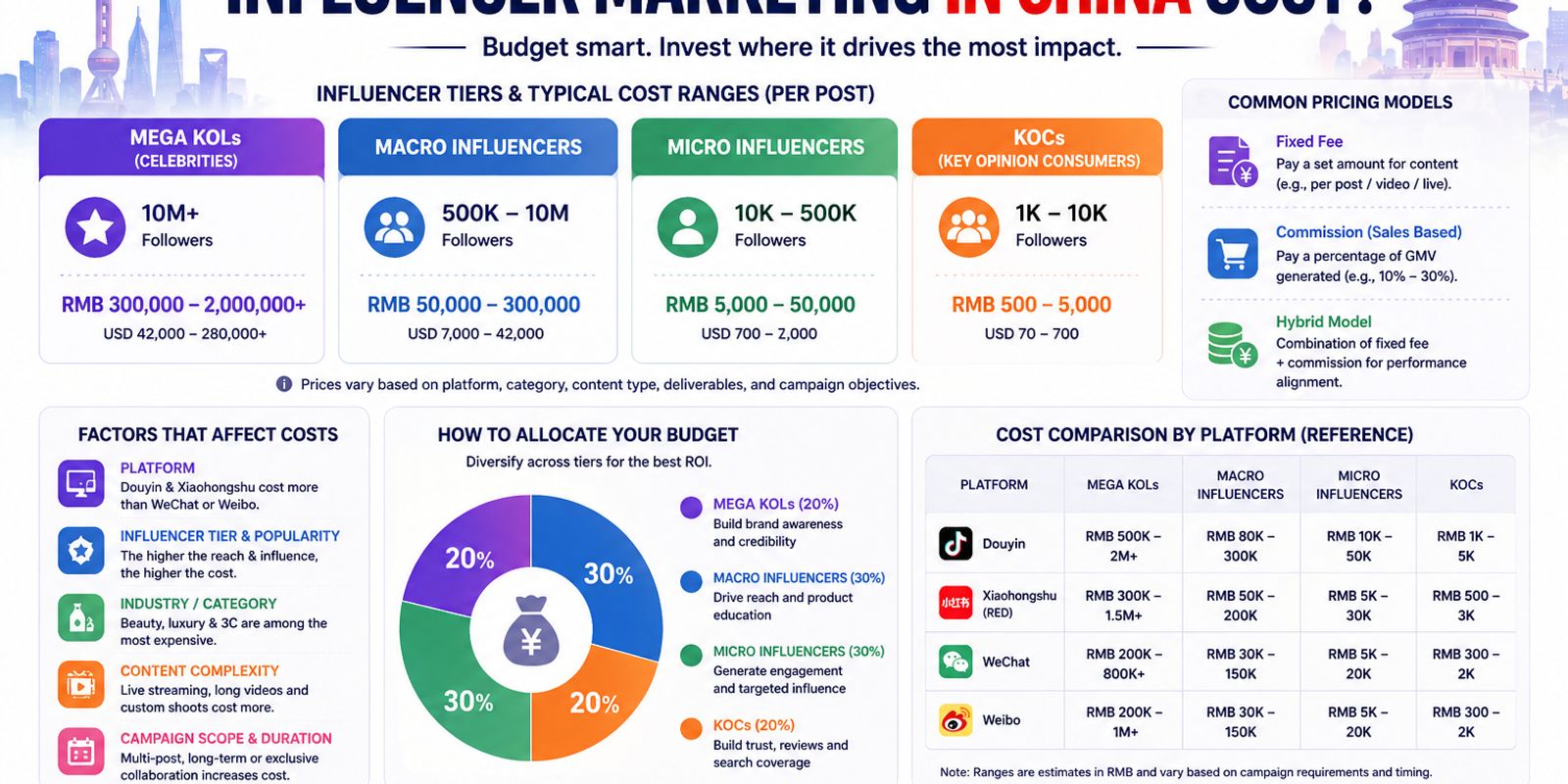
How Much Does Influencer Marketing in China Cost?
Costs vary widely depending on platform, influencer tier, and industry. Pricing models range from fixed fees to commission-based structures tied to sales performance.
KOL Pricing Models
- Fixed fee per post
- Livestream commission
- Hybrid (fee + % sales)
Factors That Affect Costs
- Platform
- Influencer tier
- Industry (beauty typically higher than B2B)
Budget Expectations for Brands
- Micro KOL: low–mid cost
- Macro: mid–high
- Top KOL: very high
A diversified approach spreading budget across multiple influencer tiers typically delivers more stable and scalable results.
How to Choose the Right KOL Marketing Agency
The most effective agencies combine local market expertise, strong influencer networks, and proven execution capabilities across platforms.
The right partner does not just deliver exposure they optimize for conversion.
Common Mistakes in KOL Marketing
- Choosing influencers based only on follower count
- Ignoring KOC strategy
- Lack of content control or briefing
- Wrong platform selection
Frequently Asked Questions (FAQs)
What is KOL marketing in China?
KOL marketing involves influencers driving both awareness and sales through content and commerce integration.
What is the difference between KOL and KOC?
KOLs drive reach; KOCs build trust.
How do I find influencers in China?
Through agencies, platforms, and influencer tools.
Is influencer marketing effective in China?
Yes it is one of the most effective channels for conversion-driven growth.
Final Thoughts on Influencer Marketing in China
Influencer marketing in China is a core growth engine, not just a marketing channel. Backed by massive user adoption, high trust in influencer recommendations, and strong integration with e-commerce, it plays a central role in China’s digital economy.
At China Digital Dynamics, the most successful campaigns combine KOL marketing china, koc marketing, and platform-specific execution. With the right strategy and data-driven approach, brands can build trust, drive conversions, and scale efficiently in China’s highly competitive market. For companies entering China in 2026, influencer marketing is no longer optional it is foundational.