'/%3e%3cpath%20d='M84%20126C60.804%20126%2042%20107.196%2042%2084C42%2060.804%2060.8041%2042%2084%2042L84%20126Z'%20fill='%235546FA'/%3e%3c/svg%3e)
How to Enter the Chinese Market - A Go-to-Market Playbook for 2026
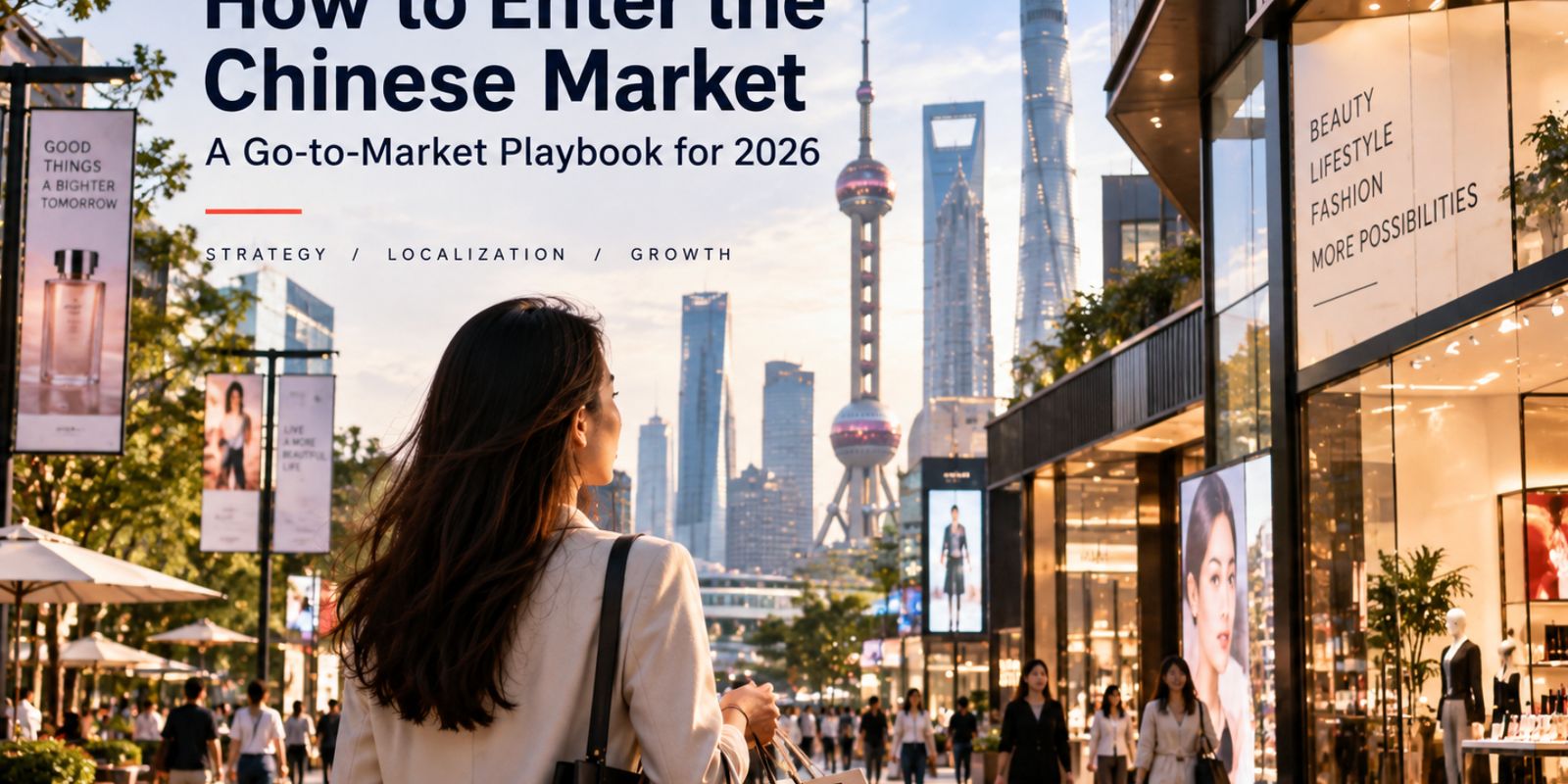
Every year, another wave of foreign brands arrives in China convinced that brand equity alone will carry them—and every year, many learn otherwise. A credible China market entry strategy for foreign brands in 2026 starts from an uncomfortable truth: China is becoming more open to foreign investment in important areas while becoming more competitive at the consumer level.
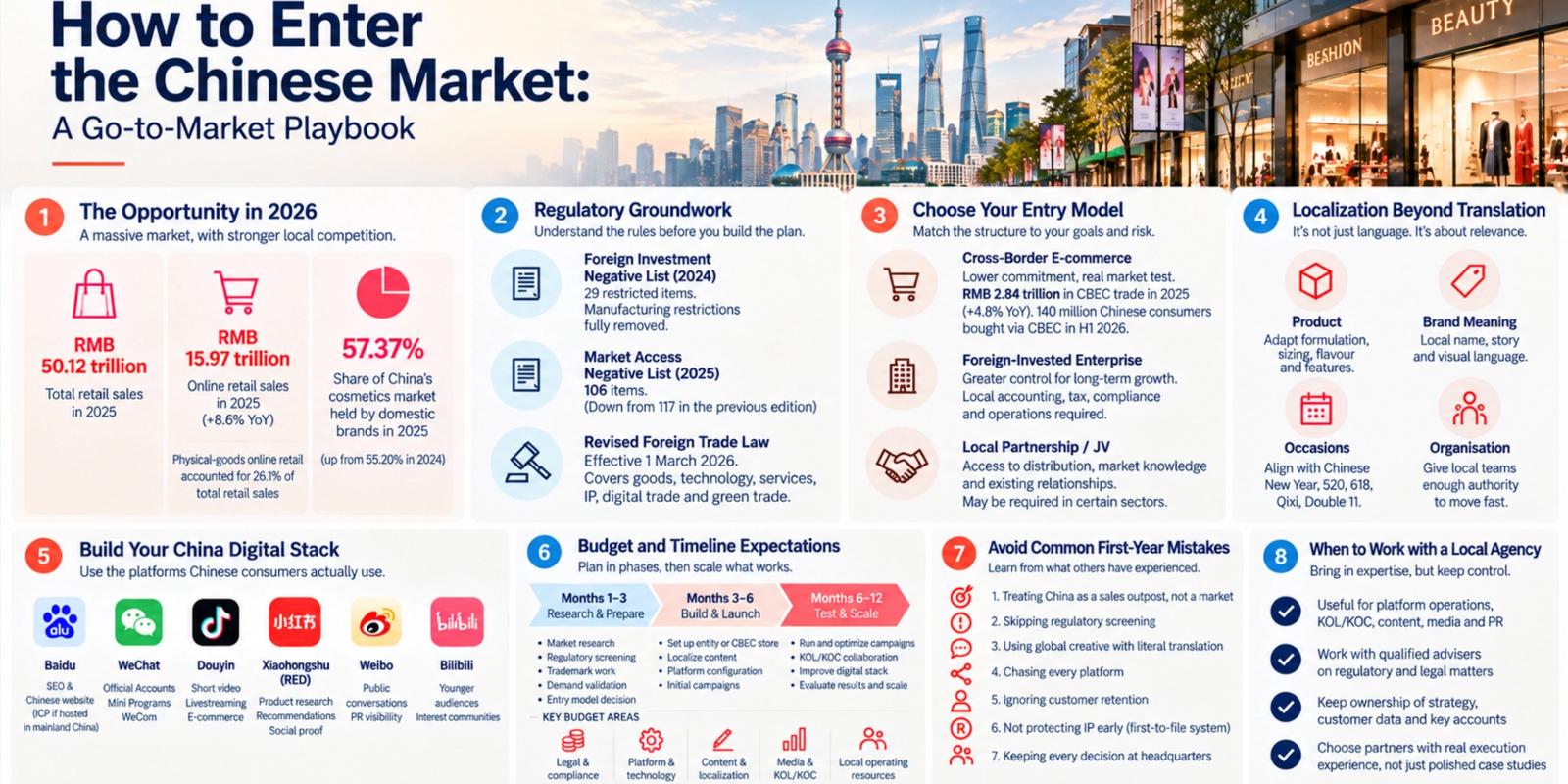
Beauty is a useful example. Domestic brands captured 57.37% of China's cosmetics market in 2025, up from 55.20% in 2024. Chinese consumers aren't necessarily rejecting foreign brands—they simply have more competitive domestic alternatives than ever before.
At the same time, the opportunity remains enormous. China's total retail sales reached RMB 50.12 trillion in 2025, while online retail sales reached RMB 15.97 trillion, up 8.6% year on year. Physical-goods online retail alone accounted for 26.1% of total retail sales of consumer goods.
The regulatory environment has also continued to evolve. The 2024 Foreign Investment Negative List removed the remaining foreign-investment restrictions in manufacturing and reduced restricted items from 31 to 29. The separate 2025 Market Access Negative List reduced listed items from 117 to 106. Meanwhile, the new 2025 Catalogue of Encouraged Industries for Foreign Investment, effective February 1, 2026, contains 1,679 entries—205 more than the previous edition with expanded encouragement for advanced manufacturing, modern services and other areas.
This playbook walks through the decisions that actually determine success research, entry model, localization, digital infrastructure, budget and the mistakes to avoid.
Market Research and Regulatory Groundwork
Market research for China entry means validating three things before spending on anything else: whether your sector is legally open to you, whether differentiated demand exists, and whether your unit economics survive local pricing. Skip any one of the three and the rest of the plan is fiction.
Regulatory screening comes first. Check your planned activity against two lists, not one:
- Foreign Investment Negative List (2024 edition, 29 items): identifies sectors prohibited or subject to special restrictions for foreign investment.
- Market Access Negative List (2025 edition, 106 items): applies to market participants more broadly. The latest edition reduced the number of listed items from 117 to 106 and national management measures from 486 to 469.
Sector not listed ≠ sector unregulated. Food, cosmetics, healthcare, telecommunications and other industries can still require specific registrations, licences or approvals.
China's revised Foreign Trade Law also took effect on March 1, 2026. The revised law covers goods, technology and services trade as well as trade-related intellectual property, and explicitly incorporates areas including digital and green trade into the legal framework.
Budget qualified local legal and regulatory advice for this phase. It is not the place to improvise.
Demand validation comes second. The most expensive sentence in China entry is: "We'll figure out product-market fit after we launch."
A practical validation stack can include Baidu search-volume and category analysis, platform-native data, competitor pricing and channel analysis, RED social listening, Douyin content research and marketplace review analysis.
For consumer brands, cross-border e-commerce can also function as a paid market test. Real transactions often tell you more about pricing, positioning and product-market fit than surveys alone.
Choosing Your Entry Model
Your entry structure determines your control, speed, tax posture and operating complexity. There is no universally correct answer—only the structure that fits your sector, ambitions and risk appetite.
Direct Entry vs Local Partnership vs Cross-Border E-commerce
Cross-border e-commerce (CBEC) can provide a lower-commitment route for eligible international brands to test Chinese demand before building a full mainland operation.
And CBEC remains substantial in 2026. China's cross-border e-commerce imports and exports reached RMB 2.84 trillion in 2025, up 4.8% year on year. In the first half of 2026 alone, 140 million consumers in China purchased through cross-border e-commerce platforms.
Platforms such as Tmall Global and JD Worldwide can therefore provide a useful route for eligible consumer brands to test demand with real transactions.
Direct entry through a foreign-invested enterprise offers greater operational control and may make sense when China becomes a long-term strategic market. It also brings local accounting, tax, employment, banking and regulatory responsibilities.
A local partnership or joint venture can provide distribution, market knowledge and existing relationships. In certain restricted sectors, local participation may also be required.
The pattern many consumer brands consider is straightforward: test demand first, then deepen the local investment once the commercial case becomes clearer.
A note on the 2026 environment: don't assume the ownership rules your company researched five years ago still apply. China's foreign-investment framework has continued to change, and the 2025 Encouraged Foreign Investment Catalogue now contains 1,679 entries, including 619 in the national catalogue and 1,060 in regional catalogues.
Re-verify your sector before deciding that a particular structure is necessary.
Localization Beyond Translation
China business localization strategy is where the majority of entries quietly fail. Translation is the smallest part of it. Real localization operates at four levels:
1. Product. Formulation, sizing, flavour, and feature sets. L’Oréal runs local R&D centres and China-first product launches; Nike builds China-specific product lines. The question to ask isn’t “how do we sell our product in China” but “which product would we design if China were our only market?”
2. Brand meaning. Your name’s Chinese rendering, your category narrative, your visual codes. Chinese consumers buy reasons, not heritage alone — domestic competitors win on ingredient transparency, clinical proof, and cultural fluency. If your brand story can’t survive a RED comment section, rewrite it before launch.
3. Occasions and calendar. China’s commercial calendar — 618, Double 11, CNY, Qixi, 520 — is the rhythm your marketing must dance to. Starbucks maintains premium positioning against Luckin partly through Chinese New Year limited editions and local food partnerships. Foreign brands that ignore the festival calendar forfeit their highest-conversion windows.
4. Organisation. Localization fails when every decision routes back to headquarters. The brands that win give their China team (or China partner) authority over pricing promotions, platform mix, and local collaborations — with global brand guardrails, not global approval chains.
Building Your China Digital Stack (Baidu, WeChat, Social, PR)
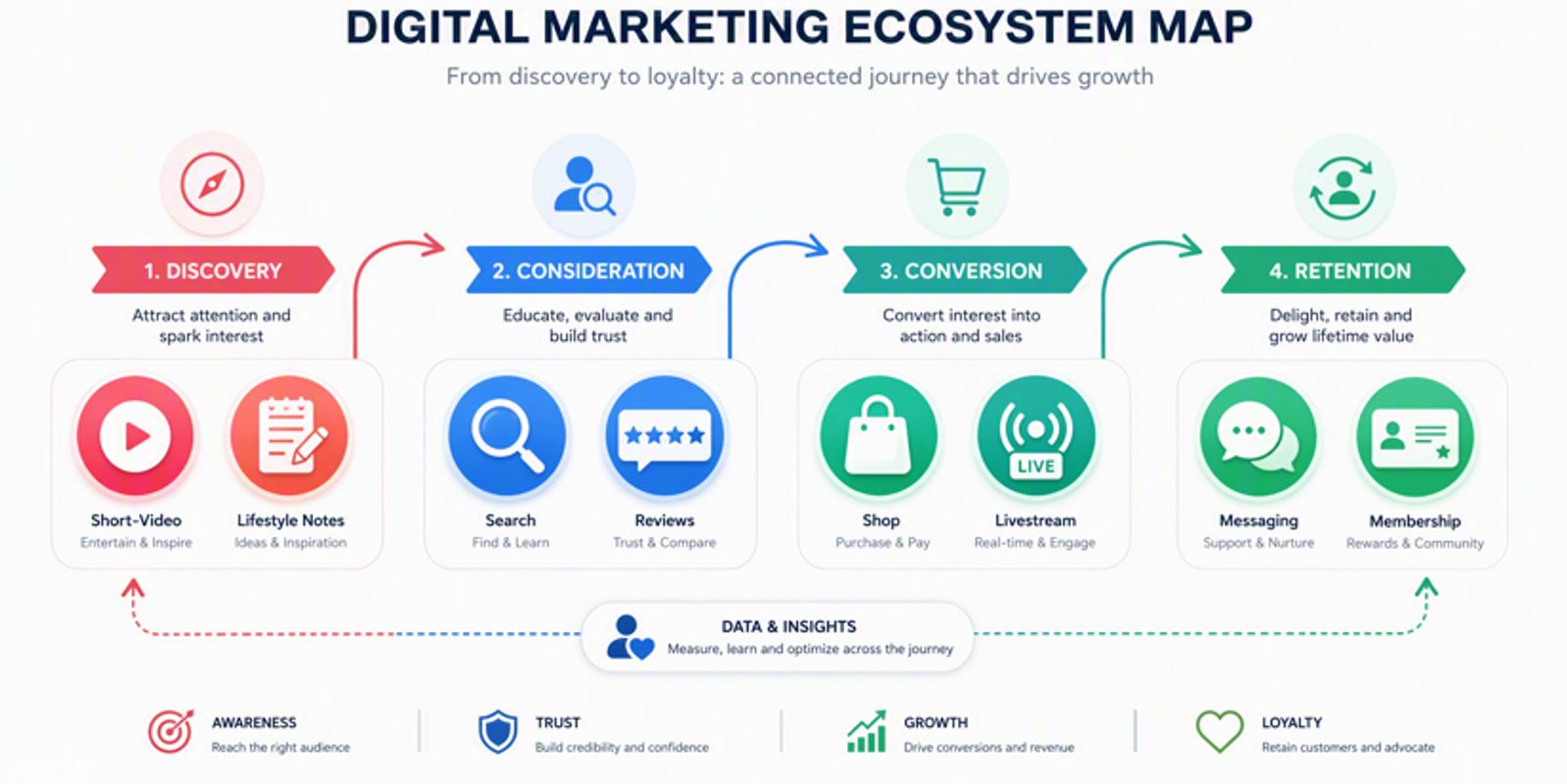
China’s internet is a separate ecosystem. Your global stack Google, Meta, Shopify, Mailchimp — is either blocked or irrelevant here. The minimum viable China ecosystem marketing 2026 stack:
- Owned web presence: A China-hosted (.cn or ICP-filed) website. Any site hosted in mainland China requires an ICP filing (ICP备案); without it, your site is unreachable or delisted. Hosting in Hong Kong avoids the filing but hurts speed and Baidu ranking.
- Search: Baidu SEO is a distinct discipline — Baidu favours Chinese-language content, mainland hosting, frequent updates, and its own product ecosystem. Google rankings tell you nothing here.
- WeChat: Non-negotiable. Official Account (content + CRM), WeChat mini-program (commerce + membership), WeCom (B2B sales and customer service). WeChat is your private-domain (私域) home — the audience you own and re-market to at near-zero marginal cost.
- Social & commerce: Douyin for discovery and livestream commerce; Xiaohongshu (RED) for trust-building and search-driven consideration; Bilibili if your audience skews Gen Z; Weibo for PR reach and crisis management.
- PR & credibility: Chinese media relations, industry KOL engagement, and — critically — local-language crisis-response protocols. Chinese consumers research foreign brands’ home-market behaviour; a misstep anywhere is visible everywhere.
Budget and Timeline Expectations
Boards consistently underbudget year one. Realistic planning figures for a consumer brand entering China in 2026 (your mileage will vary by category and ambition):
Timeline:
- Months 1–3: Research, regulatory screening, entity/CBEC route decision
- Months 3–6: CBEC store launch or WFOE registration (name approval, business licence, bank accounts, tax registration — the “5-in-1” licence consolidates much of this, but sector permits extend timelines)
- Months 6–12: Digital stack build-out, first campaigns, first festival window (aim to be live before 618 or Double 11)
Budget (indicative, mid-size consumer brand):
Line item
Lean entry (CBEC-first)
Full entry (WFOE + offline)
Legal, registration, compliance
$15–40K
$60–150K
Platform deposits & store setup
$30–80K
$80–200K
Content, localization, creative
$50–120K/yr
$150–400K/yr
Marketing & KOL spend
$150–400K/yr
$500K–2M+/yr
Local team / agency retainer
$80–200K/yr
$300K–1M+/yr
The honest framing for stakeholders: year one is a learning investment. Brands that demand first-year profitability systematically underinvest in the content and community assets that make year two and three profitable.
Avoiding the Most Common First-Year Mistakes
Patterns from entries we’ve watched go wrong:
- Treating China as a sales outpost, not a market. One junior hire plus a distributor is not a go-to-market plan China rewards. Distribution without brand-building ends in a margin death spiral.
- Skipping the regulatory screen. Discovering your sector needs a JV after signing a CBEC agency contract, or that your product needs NMPA registration with a 12–18 month runway, kills launches. Do the lists first.
- Global creative, machine-translated. Chinese consumers can smell it instantly. Budget for transcreation and local shoots, not subtitles.
- Chasing every platform. Depth on two platforms beats presence on six. For most consumer brands: RED for trust, Douyin for scale, WeChat for retention.
- No private-domain plan. Acquiring customers on Tmall or Douyin without migrating them to WeChat means renting your audience forever at rising prices.
- Ignoring IP hygiene. File your trademarks including Chinese character marks — before any market activity. China is first-to-file; trademark squatting remains a live, well-documented risk.
- Headquarters decision latency. A 48-hour approval loop for a livestream promotion misses the moment. Empower the local team or lose to those who do.
When to Bring in a Local Agency Partner
You need local help from day one; the question is which kind. A rough decision guide:
Bring in an agency or consultant when: - You lack in-house Chinese-language capability for regulatory filings (non-negotiable — hire counsel) - Your category requires platform relationships (Tmall Partner/JD partner for store operations) - You need speed: a good TP (Tmall Partner) or agency compresses 6 months of learning into 6 weeks - KOL/KOC sourcing, media buying, and content production need local execution muscle
Keep in-house (or build toward it) when: - Brand strategy and positioning never outsource your soul - Data ownership and CRM your private-domain assets should live in accounts you control - Long-term category leadership ambitions agencies are accelerators, not substitutes for a local team
The healthiest structure we see: a small senior in-house China lead who owns strategy and data, with specialised agencies executing platform operations, content, and performance marketing under clear SLAs. Choose partners who show you their client’s dashboards, not just their case-study decks and structure contracts so store accounts, ad accounts, and customer data are registered to your entity, not theirs.
Planning your China entry for 2026? Contact our team for a market-entry readiness assessment, or learn more about our China practice.
Frequently Asked Questions
What is the best way for a foreign company to enter the Chinese market?
There is no single best route. Consumer brands may use cross-border e-commerce to test demand before making a larger local investment, while other businesses may need a foreign-invested enterprise, local partner or sector-specific structure from the start.
Is cross-border e-commerce still a good way to test China in 2026?
For eligible consumer brands, CBEC remains a significant entry route. China's cross-border e-commerce imports and exports reached RMB 2.84 trillion in 2025, while 140 million Chinese consumers purchased through CBEC platforms in the first half of 2026.
Can a foreign company own 100% of a business in China?
Yes, 100% foreign ownership is permitted in many sectors, but restrictions remain in industries covered by the Foreign Investment Negative List and other sector-specific rules. The current national Foreign Investment Negative List contains 29 restricted items.
How much does it cost to enter the Chinese market?
There is no reliable universal figure. Costs depend on the entry structure, industry regulation, platform fees, inventory, localization requirements, local team and marketing ambition. A focused CBEC test can require significantly less commitment than a mainland operation with employees, distribution and offline retail.
How long does it take to enter China?
The timeline depends on the entry model. Cross-border e-commerce can provide a relatively faster testing route, while establishing a mainland business and securing sector-specific licences or product approvals can take considerably longer. Build the timeline around your actual category rather than a generic company-registration estimate.
What is the Foreign Investment Negative List?
China's Foreign Investment Negative List identifies sectors where foreign investment is prohibited or subject to special restrictions. The current national list contains 29 items. Businesses also need to consider the separate Market Access Negative List and any sector-specific licensing requirements.
Do foreign brands still succeed in China?
Yes, but the formula has changed. Chinese competitors have become stronger in product development, branding, content and e-commerce, while consumers have more choices. Foreign brands need a clear reason to be chosen supported by relevant products, localized communication and consistent execution.