'/%3e%3cpath%20d='M84%20126C60.804%20126%2042%20107.196%2042%2084C42%2060.804%2060.8041%2042%2084%2042L84%20126Z'%20fill='%235546FA'/%3e%3c/svg%3e)
How to Market Your Brand in China
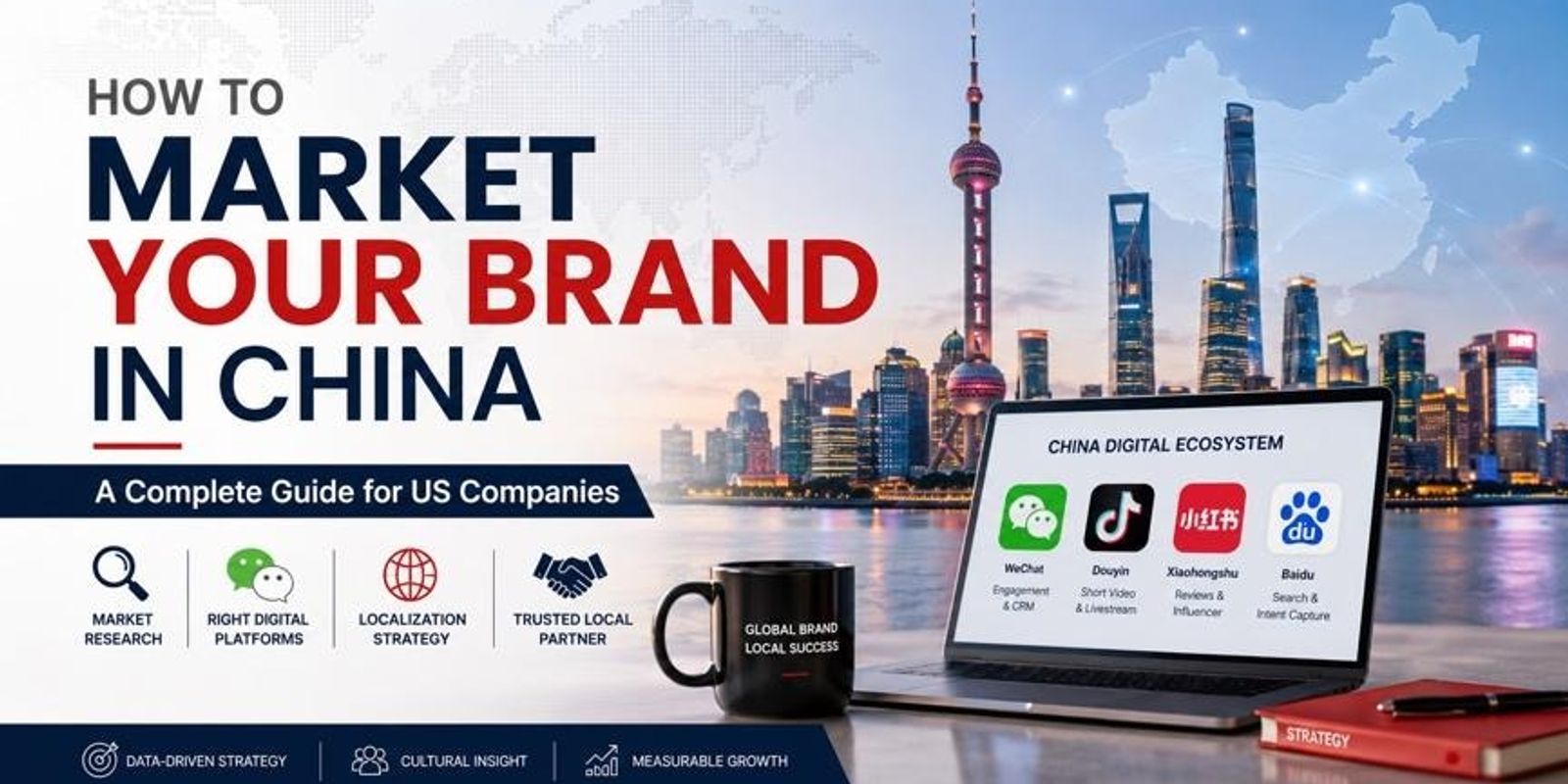
China Market Entry Strategy: Complete Guide for US Companies
China market entry requires far more than exporting products or translating your website. Companies entering China today must navigate a unique digital ecosystem, evolving consumer behavior, local regulations, and platform-driven commerce.
Quick Answer
The most successful China market entry strategy combines market research, localization, digital marketing, and local expertise.
Based on our experience helping international brands expand into China since 2015, companies that invest in understanding Chinese consumers before launch consistently outperform those that simply replicate Western marketing strategies.
China remains one of the world's largest digital consumer markets. According to the China Internet Network Information Center (CNNIC), China had approximately 1.125 billion internet users by the end of 2025, with internet penetration exceeding 80%.
This guide explains the most effective China market entry strategies, key marketing channels, common challenges, and practical steps for building a sustainable presence in China.
What Is China Market Entry?
Quick Answer
China market entry is the process of establishing a commercial presence in China through exporting, partnerships, cross-border e-commerce, licensing, franchising, or local business entities.
Depending on your goals, market entry into China may involve:
- Selling through distributors
- Launching on Chinese e-commerce platforms
- Establishing a Wholly Foreign-Owned Enterprise (WFOE)
- Forming local partnerships
- Building a direct-to-consumer digital presence
The right market entry strategy in China depends on your budget, industry regulations, growth objectives, and risk tolerance.
Why China Remains a High-Priority Market in 2026
Quick Answer
China remains one of the world's largest consumer markets, with more than 1.125 billion internet users, advanced mobile commerce infrastructure, and strong demand for international brands.
Key growth drivers include:
- More than 1.125 billion internet users
- Widespread mobile payment adoption
- Advanced e-commerce infrastructure
- Growing demand for premium international products
- Expanding consumer spending in lower-tier cities
For many US companies, the opportunity is no longer limited to Beijing, Shanghai, Guangzhou, or Shenzhen. Growth increasingly comes from digitally connected consumers across China's lower-tier cities.
According to CNNIC, internet penetration surpassed 80% by the end of 2025, creating one of the world's largest digitally connected consumer ecosystems.
Why Expanding into China Is Different
Quick Answer
China operates within a unique digital ecosystem that requires different platforms, marketing strategies, and customer engagement approaches than Western markets.
Unique Digital Ecosystem
Unlike Western markets, Chinese consumers do not rely heavily on Google, Facebook, Instagram, or YouTube for product discovery.
Instead, brands build visibility through:
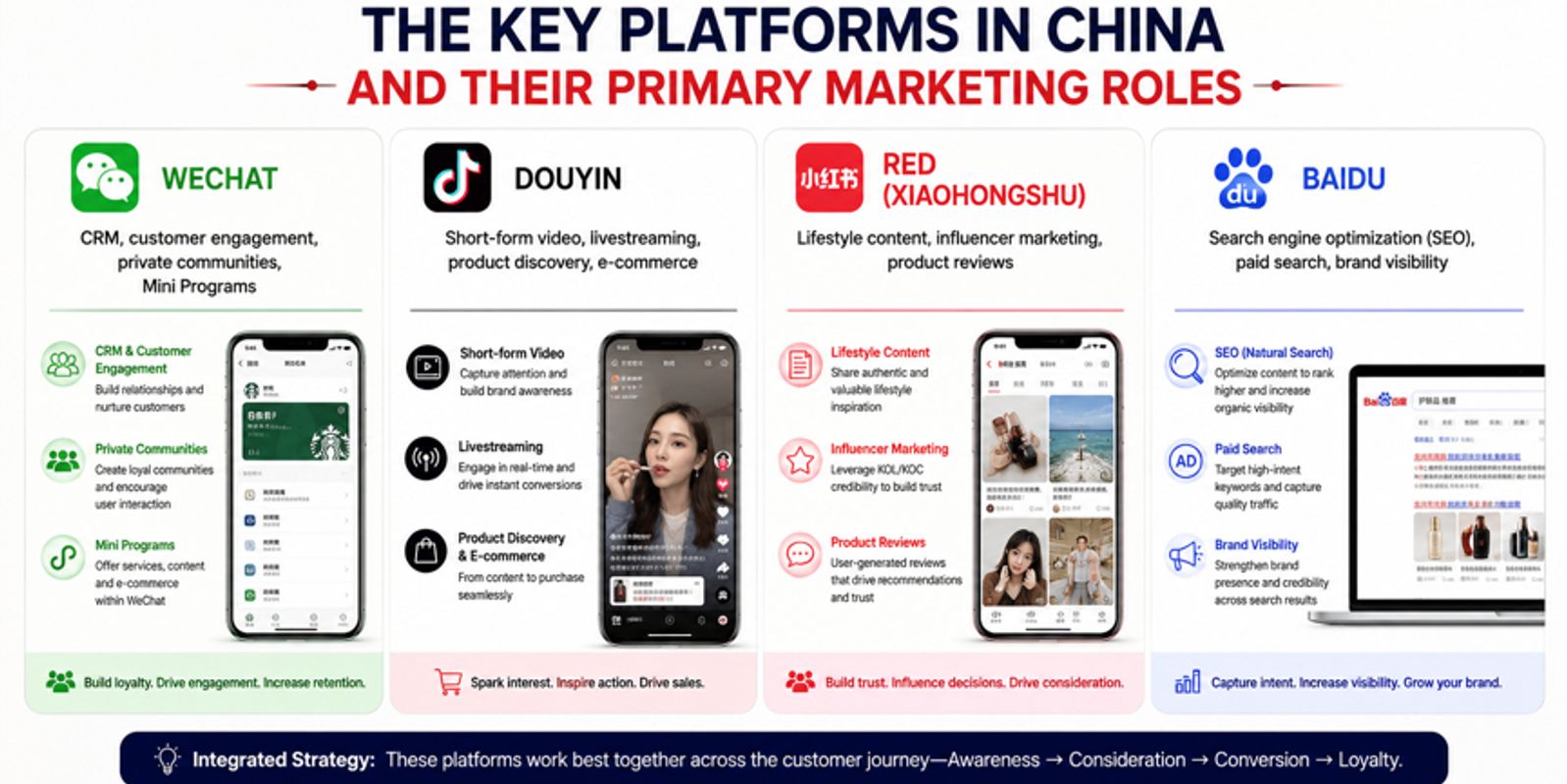
Platform
Primary Marketing Role
CRM, customer engagement, private communities, Mini Programs
Douyin
Short-form video, livestreaming, product discovery, e-commerce
RED (Xiaohongshu)
Lifestyle content, influencer marketing, product reviews
Baidu
Search engine optimization (SEO), paid search, brand visibility
A common phrase among Chinese marketers is: 先种草,再搜索,再购买
Translated: Discover first, search second, purchase third.
This reflects the typical Chinese buying journey:
- Discover products on Xiaohongshu
- Watch reviews on Douyin
- Search on Baidu
- Purchase through e-commerce or Mini Programs
Understanding this customer journey is critical when developing a market entry strategy in China.
Consumer Behavior Differences
Quick Answer
Chinese consumers typically conduct extensive research before purchasing and place significant trust in peer recommendations and user-generated content.
Many consumers evaluate products through:
- Xiaohongshu reviews
- Douyin creators
- Community discussions
- Livestream demonstrations
- Search engine research
Based on our experience managing campaigns for international brands, trust-building often plays a larger role in China than direct-response advertising alone.
Regulatory and Legal Considerations
Quick Answer
China has its own regulatory framework covering advertising, data privacy, business registration, and industry-specific licensing.
Before entering the market, companies should evaluate:
- Trademark registration
- Business structure
- Product compliance requirements
- Advertising regulations
- Data privacy obligations
Consulting qualified legal and regulatory professionals is strongly recommended before making significant investments.
Top China Market Entry Strategies
Quick Answer
The best China market entry strategy depends on your budget, speed-to-market requirements, and long-term business goals.
Cross-Border E-Commerce
For many overseas brands, cross-border e-commerce is the fastest and lowest-risk way to enter China.
Benefits include:
- Lower startup costs
- Faster market testing
- Reduced regulatory complexity
- Direct consumer access
China's cross-border e-commerce trade volume reached approximately RMB 2.75 trillion in 2025.
Cross-border e-commerce is often the preferred entry model for brands that want to validate demand before establishing local operations.
Wholly Foreign-Owned Enterprise (WFOE)
Quick Answer
A WFOE allows foreign companies to establish and operate a business independently in China.
Best suited for:
- Long-term expansion
- Local hiring
- Direct sales operations
- Greater operational control
However, setup costs and compliance requirements are significantly higher than cross-border models.
Joint Ventures
Joint ventures involve partnering with a Chinese company.
Potential advantages include:
- Local expertise
- Existing relationships
- Faster market access
Potential disadvantages include:
- Shared decision-making
- Governance complexity
- Potential strategic conflicts
The right structure depends on your industry, resources, and growth plans.
Step-by-Step China Market Entry Plan
#Step 1: Conduct Market Research Before You Launch
Before entering China, validate demand.
Key research areas include:
- Consumer preferences
- Pricing expectations
- Competitor positioning
- Platform behavior
- Chinese keyword research
Brands that invest in pre-launch market validation typically reduce entry risk and improve marketing ROI by aligning early with local demand signals.
#Step 2: Analyze Local Competitors
Competitor analysis helps define realistic market positioning.
Evaluate:
- Product positioning
- Pricing strategy
- Customer reviews
- Influencer activity (KOL/KOC)
- Social media engagement
In China, competitor benchmarking often reveals expectations that differ significantly from Western markets, especially around pricing psychology, branding tone, and content style.
#Step 3: Choose the Right Marketing Platforms
Platform selection should match user behavior, not brand preference.
WeChat: Build Long-Term Customer Relationships
WeChat is a full ecosystem, not just a messaging app.
It supports:
- Brand content publishing
- CRM and customer segmentation
- Loyalty programs
- Mini Programs for e-commerce
- Private community management
- Customer service integration
One-line takeaway: WeChat is the backbone of long-term customer retention in China.
Douyin: Accelerate Awareness and Sales
Douyin is China’s leading short-video commerce engine.
Brands use it for:
- Viral short-form video content
- Livestream selling
- Influencer collaborations
- Performance-based advertising
Industries such as beauty, fashion, electronics, and FMCG often see the strongest ROI.
One-line takeaway: Douyin is the fastest channel for scalable brand awareness and direct conversion.
Xiaohongshu (RED): Build Trust Through Authentic Content
Chinese consumers rely heavily on peer reviews before purchasing.
RED is a key platform for:
- Product reviews
- User-generated content (UGC)
- Lifestyle inspiration
- Influencer recommendations
- Community discussions
For premium and lifestyle brands, RED is often the first touchpoint for trust building.
One-line takeaway: Xiaohongshu is where purchase intent is formed through social proof.
Baidu: Capture High-Intent Search Traffic
Search remains critical in the Chinese digital ecosystem.
Users rely on Baidu for:
- Brand verification
- Product comparison
- Problem-solving searches
- Purchase decision validation
SEO and paid search help brands capture high-intent users actively evaluating solutions.
One-line takeaway: Baidu captures demand at the final decision stage.
#Step 4: Localization Is More Than Translation
Localization goes far beyond language conversion.
Effective localization includes:
- Chinese brand naming
- Culturally relevant messaging
- Localized visual identity
- Customer service adaptation
- Integration of local payment systems
Based on experience supporting international brands since 2015, direct translation rarely performs well in China. Brands that localize messaging, creative direction, and customer journeys consistently achieve higher engagement and conversion rates.
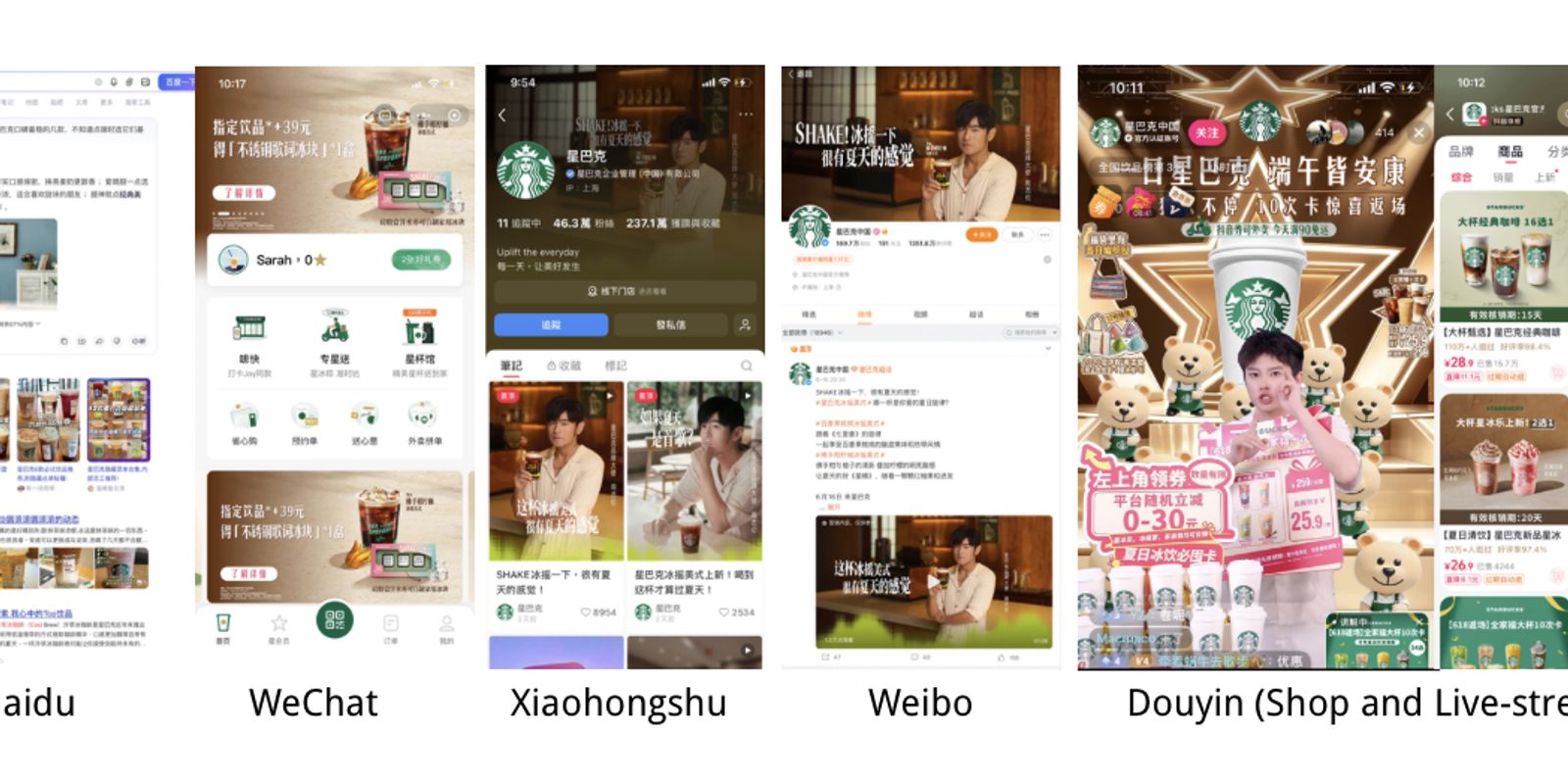
Example: Starbucks in China
Starbucks is a strong example of successful localization in the Chinese market.
Instead of replicating its U.S. model, Starbucks:
- Adapted product offerings to local taste preferences, including collaborations and culturally relevant flavors
- Leveraged celebrity influence, including partnerships and endorsements such as Jay Chou
- Redesigned store experiences to support social interaction and “third space” culture
- Integrated deeply with WeChat for loyalty programs, payments, and customer engagement
- Built a digital-first customer ecosystem through Mini Programs and online-to-offline integration
- Leveraged livestreaming and digital campaigns to promote limited-time offers and discounts
One-line takeaway: Starbucks succeeded by combining global brand identity with a China-native digital and social ecosystem.
By doing so, China became Starbucks’ second-largest market—demonstrating that success in China requires adaptation rather than replication.
# Step 5: Launch and Marketing Execution
Once strategy is defined, execution must be platform-specific.
Common launch channels include:
- WeChat campaigns
- Douyin advertising and livestreaming
- Xiaohongshu influencer seeding
- Baidu SEO optimization
- Baidu paid search (SEM)
Continuous optimization is essential, as Chinese consumer behavior responds quickly to content trends and social proof signals.
Best Marketing Channels for Entering China
Best for: retention, CRM, loyalty programsRole: Long-term customer relationship management
Douyin
Best for: awareness, traffic, conversions Role: High-speed customer acquisition
Xiaohongshu (RED)
Best for: reviews, trust, discoveryRole: Pre-purchase influence and social proof
Baidu
Best for: search, comparison, intent trafficRole: Final-stage decision support
China marketing success requires a multi-platform strategy across WeChat, Douyin, RED, and Baidu.
Working With a China Marketing Agency
Many international companies partner with local agencies to navigate complexity in execution, compliance, and platform strategy.
A capable China marketing agency should provide:
- Local market research
- Digital strategy development
- Social media management
- Baidu SEO & SEM
- KOL/KOC influencer marketing
- Public relations support
- Localization services
- Campaign analytics and reporting
Avoid selecting partners based on vanity metrics such as follower count or impressions alone. Focus on measurable outcomes such as leads, conversions, and long-term brand growth.
Key Challenges of Entering the Chinese Market
Many foreign companies underestimate:
- Regulatory complexity
- Localization requirements
- Consumer behavior differences
- Strong local competition
The most common mistake is treating China as simply another international market rather than a unique digital ecosystem.
Frequently Asked Questions
What is the best way to enter the Chinese market?
For many businesses, cross-border e-commerce is the fastest and lowest-risk market entry strategy because it allows brands to test demand before establishing a local entity.
How much does it cost to enter China?
Costs vary significantly. Small market validation projects may start below $20,000, while establishing a WFOE and full marketing operation can require several hundred thousand dollars.
Can US companies sell directly in China?
Yes. US companies can sell through distributors, cross-border e-commerce platforms, partnerships, or locally registered entities depending on their business objectives and industry requirements.
How AI Is Changing China Market Entry
Quick Answer
Artificial intelligence is transforming how Chinese consumers discover brands, compare products, and make purchasing decisions.
Search platforms increasingly provide AI-generated answers rather than simple lists of links. Consumers are also using AI-powered assistants to research products and services.
This means brands entering China should focus on:
- Building topical authority
- Creating trustworthy content
- Publishing expert insights
- Maintaining consistent brand information across platforms
- Earning positive reviews and third-party mentions
According to China's Internet Development Report, generative AI adoption exceeded 600 million users by the end of 2025.
Brands that establish credibility across Baidu, WeChat, Xiaohongshu, and industry media are increasingly more visible in AI-generated search results and recommendations.
Final Thoughts
There is no universal China market entry strategy. Success depends on industry, budget, and long-term positioning goals.
However, strong market entry strategies consistently rely on four pillars:
- Research-driven decisions
- Deep localization
- Platform-specific execution
- Local expertise and partnerships
China’s digital ecosystem continues to evolve rapidly. Companies that invest in understanding local consumer behavior and adapting accordingly will be best positioned for sustainable growth.
Since 2015, China Digital Dynamics has supported international brands with market research, localization, Baidu SEO, social media strategy, and full-funnel China market entry execution.
Book a complimentary strategy consultation with China Digital Dynamics to explore your China growth opportunities.