'/%3e%3cpath%20d='M84%20126C60.804%20126%2042%20107.196%2042%2084C42%2060.804%2060.8041%2042%2084%2042L84%20126Z'%20fill='%235546FA'/%3e%3c/svg%3e)
China Gaming Regulation Update 2026
China remains one of the world's most important—and closely regulated—video game markets. For developers, publishers, investors, and global gaming companies, following China gaming regulation news 2026 means looking beyond individual policy announcements. Game approvals, content compliance, minor protection, real-name verification, data governance, monetization practices, and emerging AI rules all form part of an increasingly interconnected regulatory environment.
The key development in 2026 is not necessarily a single dramatic regulatory reset. Instead, companies are operating within a more established regulatory framework while watching closely for changes in game licensing, player protection, emerging technologies, and digital-content governance. According to Niko Partners, game approvals in China are up 19% year-to-date compared to 2025, with 754 domestic titles and 25 imported titles approved in 2026 as of May.
For companies searching for China gaming regulations news today, the practical priority is therefore to separate confirmed regulatory changes from draft proposals, market speculation, and policies affecting the wider digital economy.
Overview of China's Gaming Regulations in 2026
China's gaming industry operates within a comprehensive regulatory framework that governs every stage of a game's lifecycle—from development and publication to live operations and post-launch updates.
Unlike many international markets where publishers can release games directly through digital storefronts, commercial games in mainland China generally require regulatory approval before launch. Developers must also ensure compliance with regulations covering:
- Game publishing approvals
- Content review and censorship
- Real-name registration
- Minor protection systems
- Data security and privacy
- Online service compliance
- Virtual currency and monetization
- Cybersecurity requirements
These regulations are designed to balance industry growth with government objectives surrounding digital content governance, cybersecurity, cultural values, and youth protection.
For overseas publishers, localization extends well beyond language translation. Games often require adjustments to storytelling, artwork, monetization systems, player identity verification, and technical infrastructure before they can enter the Chinese market.
As a result, regulatory planning has become a core component of successful China market-entry strategies rather than a final compliance checklist.
Latest China Gaming Regulation News and Policy Updates
As of mid-2026, companies should be cautious about describing every policy discussion as a new gaming regulation.
One notable example is the draft regulations on digital virtual humans released in April 2026. Although these proposals are not gaming regulations in the strict sense, they illustrate how artificial intelligence, digital identities, and interactive content are becoming more closely regulated.
The draft framework addresses issues including:
- AI-generated virtual personalities
- Identity disclosure requirements
- Personal information protection
- Content authenticity
- Minor protection measures
- Platform responsibilities
For game developers building AI companions, intelligent NPCs, virtual influencers, or immersive multiplayer experiences, these adjacent regulations could eventually influence product design and compliance strategies.
Another important trend is the government's continued emphasis on responsible platform governance. Regulatory attention increasingly extends beyond game publishing itself to include recommendation algorithms, online communities, digital content moderation, and user-generated content.
Businesses searching for China gaming regulations news today should therefore monitor developments across China's wider digital economy rather than focusing solely on game approvals.
Key Regulatory Changes Affecting the Gaming Industry
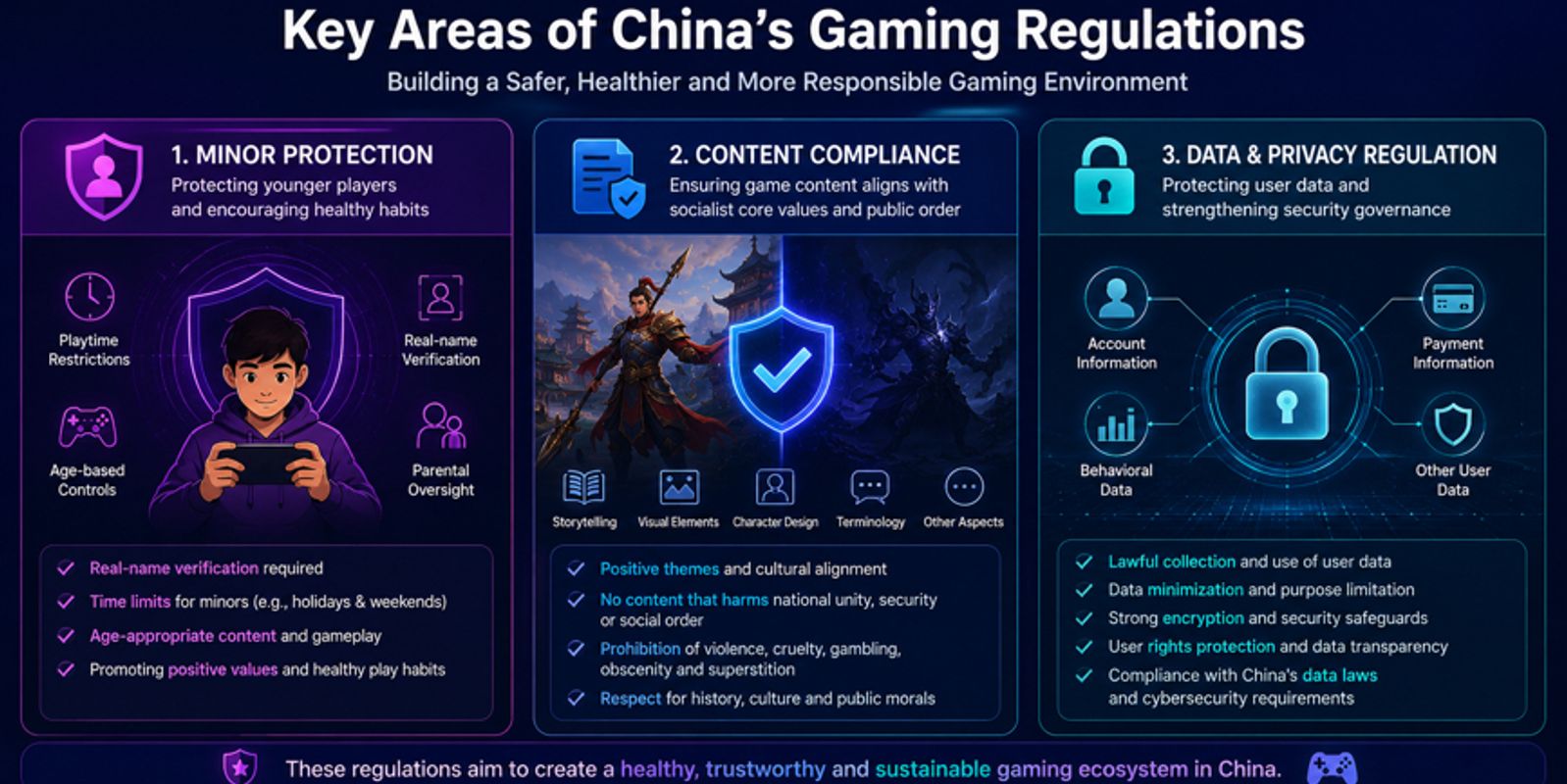
Several established regulatory areas continue to shape how games operate in China.
One of the most important is game approval and licensing. Commercially published games generally need to obtain the relevant approval before entering the domestic market.
Minor protection remains another central area. China's rules restrict how younger users can access online games and require systems supporting real-name verification.
Content compliance can affect storytelling, visual elements, character design, terminology, and other aspects of a game.
Data and privacy regulation also matters because online games may process account information, behavioral data, payment information, and other user data.
Finally, monetization practices remain an area that publishers should monitor carefully. Proposed regulatory measures can generate significant industry attention even before they become final rules, making it essential to distinguish consultation drafts from regulations that have formally taken effect.
The practical lesson is that compliance should not be treated as a final pre-launch checklist. It should be incorporated into development and publishing strategy from an early stage.
The Role of the National Press and Publication Administration (NPPA)
The National Press and Publication Administration (NPPA) remains the primary authority responsible for regulating commercial game publishing in China.
Its responsibilities include reviewing and approving both domestic and imported online games before commercial release.
Although many businesses casually refer to obtaining a "game license" or "ISBN," the approval process is considerably more comprehensive than simple product registration.
Publishers typically prepare extensive documentation covering:
- Product information
- Content descriptions
- Technical specifications
- Publishing arrangements
- Compliance materials
- Required supporting documentation
For imported games, overseas developers generally cannot publish independently. Instead, they work with qualified domestic publishing partners responsible for submitting applications and coordinating with regulators.
This partnership model means publishers should involve local experts early in development rather than waiting until localization is complete.
NPPA approval timelines also affect broader commercial planning, including marketing campaigns, launch scheduling, server preparation, and regional publishing strategies.
The approval process should therefore be viewed as an integral component of product planning rather than an administrative requirement completed at the end of development.
How China's Gaming Regulations Impact Developers and Publishers
China's regulatory environment influences virtually every stage of game development.
A successful title released globally cannot simply be translated into Simplified Chinese and published unchanged.
Instead, developers often review multiple areas before submission, including:
- Narrative and dialogue
- Character appearance
- Maps and artwork
- Payment systems
- User account management
- Data handling procedures
- Social interaction features
- AI-generated content
- Minor protection functions
Conducting compliance reviews early helps reduce expensive redesigns later in production.
Increasingly, experienced publishers integrate regulatory assessment directly into localization workflows, allowing product, legal, engineering, and publishing teams to collaborate throughout development.
For international studios, proactive compliance planning improves approval readiness, shortens revision cycles, and reduces uncertainty during launch preparations.
Game Approval Trends and Licensing Updates in 2026
Game approvals remain one of the most closely watched indicators of regulatory conditions in China's gaming industry.
The publication of approval lists gives developers and investors visibility into which domestic and imported titles have received authorization to enter the market.
However, monthly approval numbers should be interpreted carefully.
A higher number of approvals does not necessarily mean that every area of regulation is becoming less restrictive. Likewise, a slower month does not automatically indicate a new regulatory crackdown.
Approval activity can be affected by submission timing, product pipelines, review processes, and other factors.
For developers, the more useful question is not simply, "How many games were approved this month?" It is whether the overall approval process is sufficiently consistent for companies to plan product pipelines with greater confidence.
Global publishers should also remember that imported titles face a different market-entry path from domestically developed games.
Regulations on Monetization, In-Game Purchases, and Player Protection
Monetization remains one of the most sensitive areas of online gaming regulation.
China's gaming market makes extensive use of free-to-play business models, virtual items, in-game currencies, and other forms of digital spending. At the same time, regulators have maintained a strong focus on consumer protection and the behavior of younger players. This means developers should carefully evaluate systems involving randomized rewards, spending incentives, virtual currencies, and time-limited mechanics.
Minor protection is particularly important. Online games are subject to real-name verification requirements and restrictions designed to limit gaming time for underage users. Publishers need technical systems capable of implementing applicable requirements rather than relying only on terms and conditions.
The broader regulatory direction suggests that player protection will remain important, particularly as games become more social, immersive, and AI-driven. Female players now represent 42% of the player base across Asia and MENA, up from approximately 40% the prior year, highlighting the growing diversity of gaming audiences that regulations must consider.
Market Reactions to China's Latest Gaming Policies
Gaming regulation in China can have an immediate effect on market sentiment.
This is partly because China is such an important source of players and revenue for major gaming companies. Even proposed rules can therefore attract attention from investors, publishers, and international media.
However, market reactions do not always predict final regulatory outcomes.
Draft measures may be revised. Policy language may be clarified. Implementation details may change.
For this reason, companies should avoid making strategic decisions based solely on headlines or short-term stock-market movements.
A more reliable approach is to assess three questions: Has the policy formally taken effect? Which companies and products fall within its scope? What operational changes are actually required?
This distinction is particularly important for anyone following fast-moving searches such as China gaming regulations news today, where breaking-news coverage may appear before the full regulatory implications are clear.
What Global Game Companies Need to Know About China's Regulatory Environment
China remains a major commercial opportunity, but market entry requires preparation. China's gaming market reached $51.8 billion in 2025, crossing the $50 billion mark for the first time, and is expected to grow 4% in 2026 to $53.9 billion. With 769 million players expected by 2030, the commercial opportunity remains substantial for companies that navigate the regulatory landscape effectively.
Global developers should not assume that a game successful elsewhere can be launched unchanged in mainland China.
Regulatory planning should begin early and should be integrated with localization, publishing, and commercial strategy.
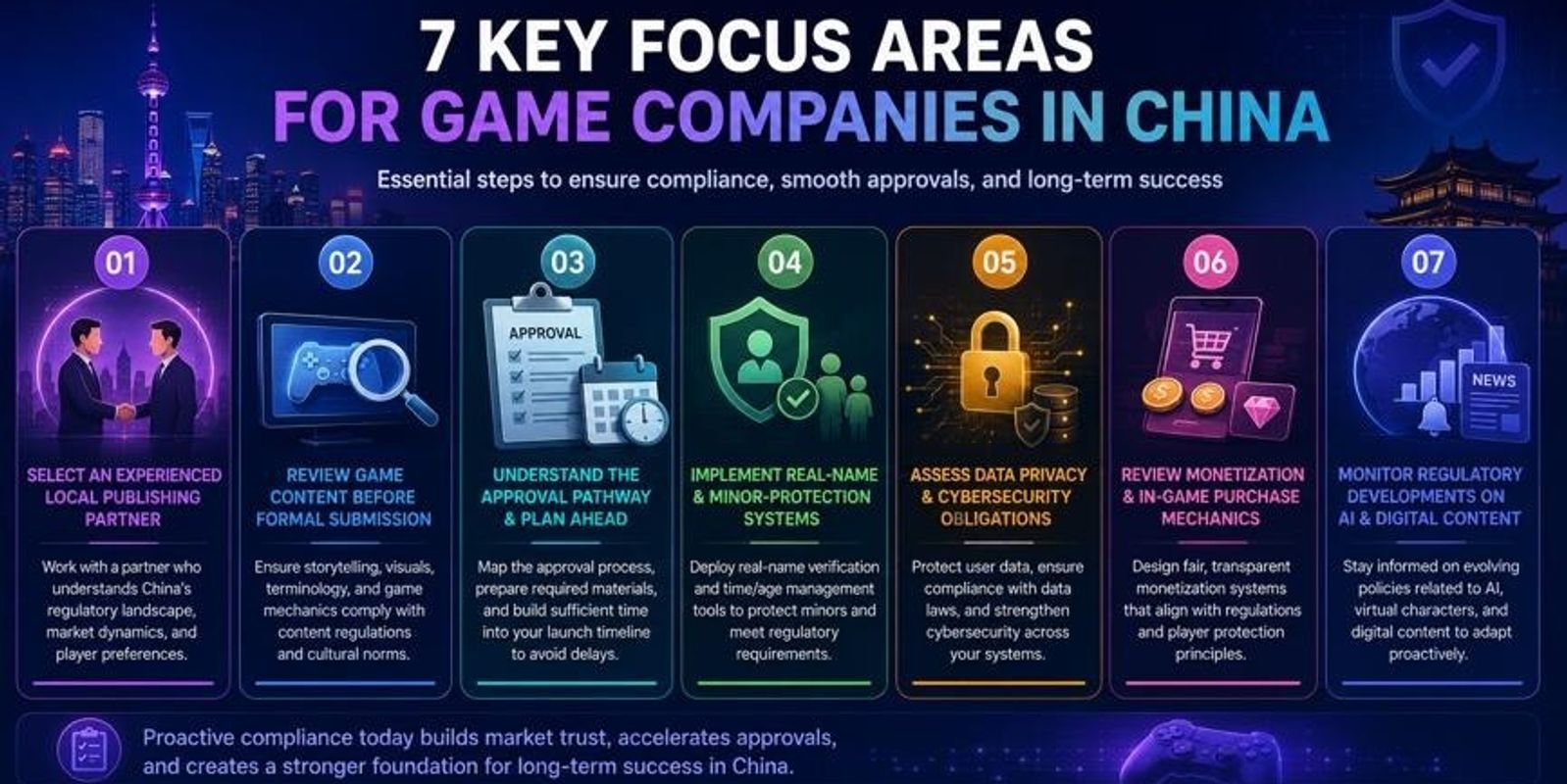
Companies should pay particular attention to:
- Partnering with experienced Chinese publishers
- Conducting content compliance reviews early
- Building realistic approval timelines into launch schedules
- Implementing compliant real-name verification systems
- Meeting cybersecurity and data protection obligations
- Reviewing monetization mechanics before submission
- Monitoring AI, digital content, and platform governance policies
Localization should also extend beyond compliance.
Chinese players have distinct platform preferences, payment behaviors, content expectations, and community ecosystems. A regulatory-compliant game still needs strong product-market fit to succeed.
Future Outlook for China's Gaming Regulations
China's gaming regulatory environment in the coming years is likely to be shaped by two parallel priorities: supporting a significant digital industry while maintaining oversight of online content, younger users, data, and emerging technologies.
Greater consistency in game approvals could help publishers plan their pipelines more effectively.
At the same time, new technologies will create new regulatory questions.
Generative AI, intelligent NPCs, virtual humans, cloud gaming, immersive environments, and increasingly sophisticated social features can blur traditional boundaries between games, social platforms, and AI services.
The April 2026 proposals concerning digital virtual humans provide one example of how emerging forms of digital interaction can attract new governance frameworks.
For gaming companies, this means regulatory monitoring will increasingly need to extend beyond the NPPA.
The most resilient companies will build compliance into product development, maintain strong local expertise, and distinguish confirmed rules from proposals and speculation.
In China's gaming market, regulatory understanding is not simply about avoiding risk. It can also become a competitive advantage.
Frequently Asked Questions
What are the latest gaming regulations in China?
The latest China gaming regulation news 2026 indicates continued oversight of game publishing, content compliance, real-name verification, player protection, cybersecurity, and data governance. Developers should also monitor evolving policies relating to AI, digital humans, and online content governance while distinguishing final regulations from consultation drafts.
Who regulates the gaming industry in China?
The National Press and Publication Administration (NPPA) is the primary authority responsible for approving commercial game publications in China. Depending on the subject matter, other government agencies may also oversee cybersecurity, personal information protection, online content, artificial intelligence, and digital platform governance.
How do China's gaming regulations affect developers?
China's regulations influence content design, publishing partnerships, localization strategies, licensing timelines, real-name verification systems, player protection features, data handling practices, and monetization mechanics. Early regulatory planning can significantly reduce development costs and improve launch readiness.
How does the game approval process work in China?
Commercial games generally require regulatory approval before being released in mainland China. Overseas developers usually collaborate with qualified Chinese publishing partners who prepare submission materials, coordinate regulatory reviews, and manage the approval process before commercial launch.
What can the gaming industry expect from future regulatory changes?
Future regulations are expected to focus on balancing industry growth with oversight of player protection, AI technologies, online content, cybersecurity, and digital governance. Emerging technologies such as generative AI, intelligent NPCs, virtual humans, and immersive gaming environments are likely to receive increasing regulatory attention.