'/%3e%3cpath%20d='M84%20126C60.804%20126%2042%20107.196%2042%2084C42%2060.804%2060.8041%2042%2084%2042L84%20126Z'%20fill='%235546FA'/%3e%3c/svg%3e)
Baidu PPC for Foreign Companies - Setup, Costs, and Strategy
If Google Ads is muscle memory for your marketing team, China will force you to relearn the motion. Baidu PPC advertising for foreign companies runs on a different rulebook: Chinese-language search behavior, stricter advertiser verification, local advertising regulations and a platform ecosystem built specifically for the Chinese internet.
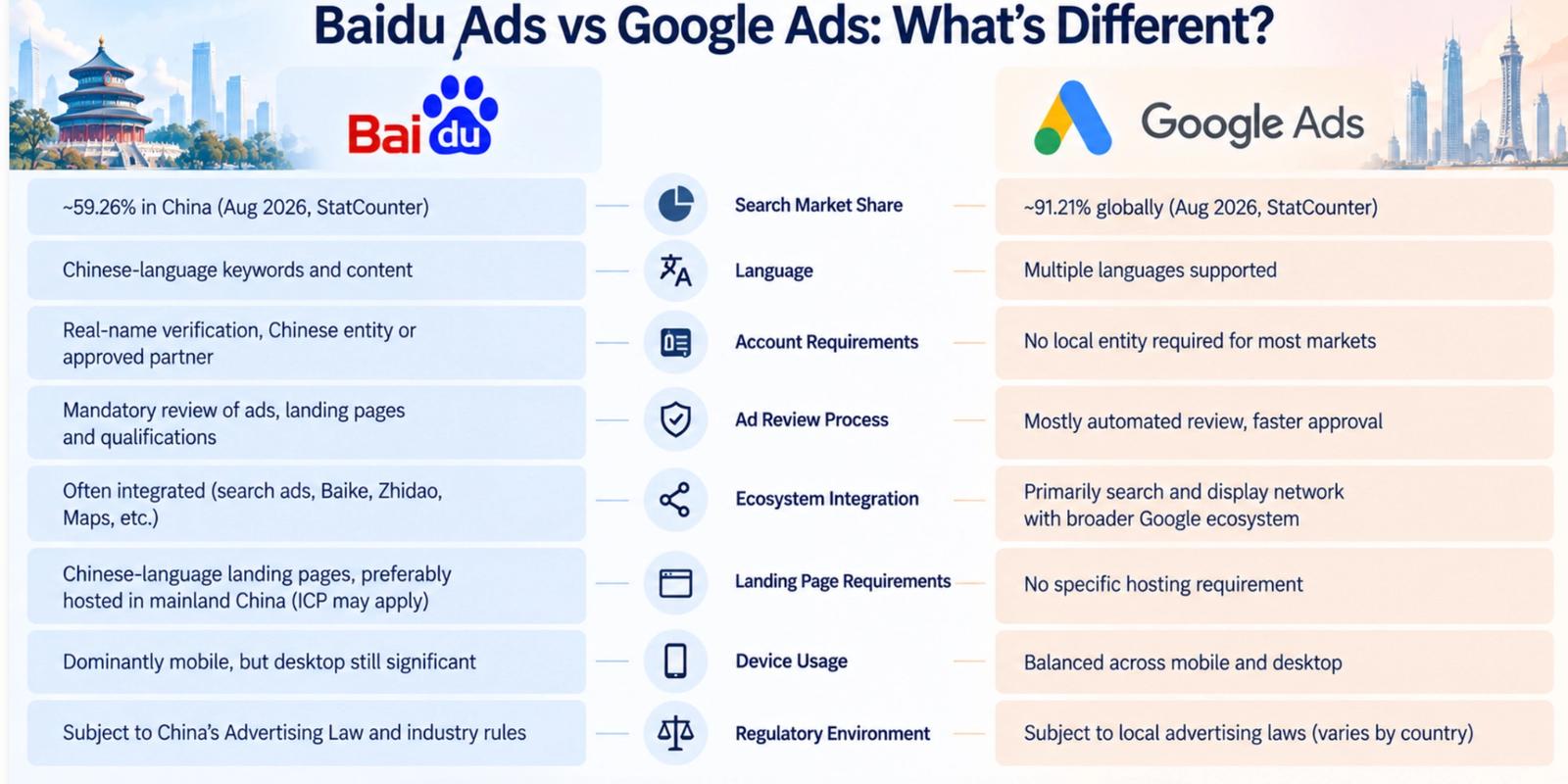
And Baidu still matters. According to StatCounter, Baidu held 59.26% of China's search-engine market in August 2026, compared with 18.92% for Bing and 1.41% for Google. On desktop alone the picture is more competitive—Bing held 39.4% versus Baidu's 36.9%—which is one reason channel planning should consider audience and device rather than relying on one headline market-share number.
Baidu itself reported 644 million monthly active users for the Baidu App in June 2026. At the same time, its advertising business is changing: Baidu reported RMB 2.6 billion in AI-native marketing-services revenue in Q2 2026 as it continues integrating AI more deeply into search and marketing products.
The good news is that the barriers to entry are mostly procedural rather than mysterious. The challenge is getting the account structure, qualifications, Chinese landing pages and campaign strategy right from the beginning.
This guide explains what Baidu SEM account setup involves in 2026, how Baidu differs from Google Ads, what foreign advertisers should prepare, and how to build campaigns around Chinese search behavior rather than simply translating a global PPC account.
Baidu Ads vs Google Ads: What’s Different
Baidu Ads and Google Ads share the basic logic of keyword-based paid search, but they differ significantly in advertiser verification, Chinese-language search behavior, landing-page requirements, ad review and the wider platform ecosystem.
The campaign logic will feel familiar to experienced PPC teams. You still organize campaigns and ad groups, choose keywords, write ads, set bids, build landing pages and optimize toward conversions.
What changes is everything around that process.
Baidu operates a real-name advertiser system. Its current account-opening guidance says company information should correspond with the website owner, actual controller or operator, and that the registered primary domain should match the primary domain used by keyword landing URLs.
Creative also operates within China's advertising-law environment. Claims such as “national-level,” “highest-level” and “best” are specifically addressed by Article 9 of China's Advertising Law, while 2026 regulatory guidance has reinforced scrutiny of claims such as “first,” “best” and “leading,” particularly when supporting evidence or context is inadequate.
That makes substantiation more important than clever copy.
For foreign advertisers, the main lesson is simple: don't copy your Google Ads campaigns, translate them into Chinese and expect the same result.
Business Verification Requirements
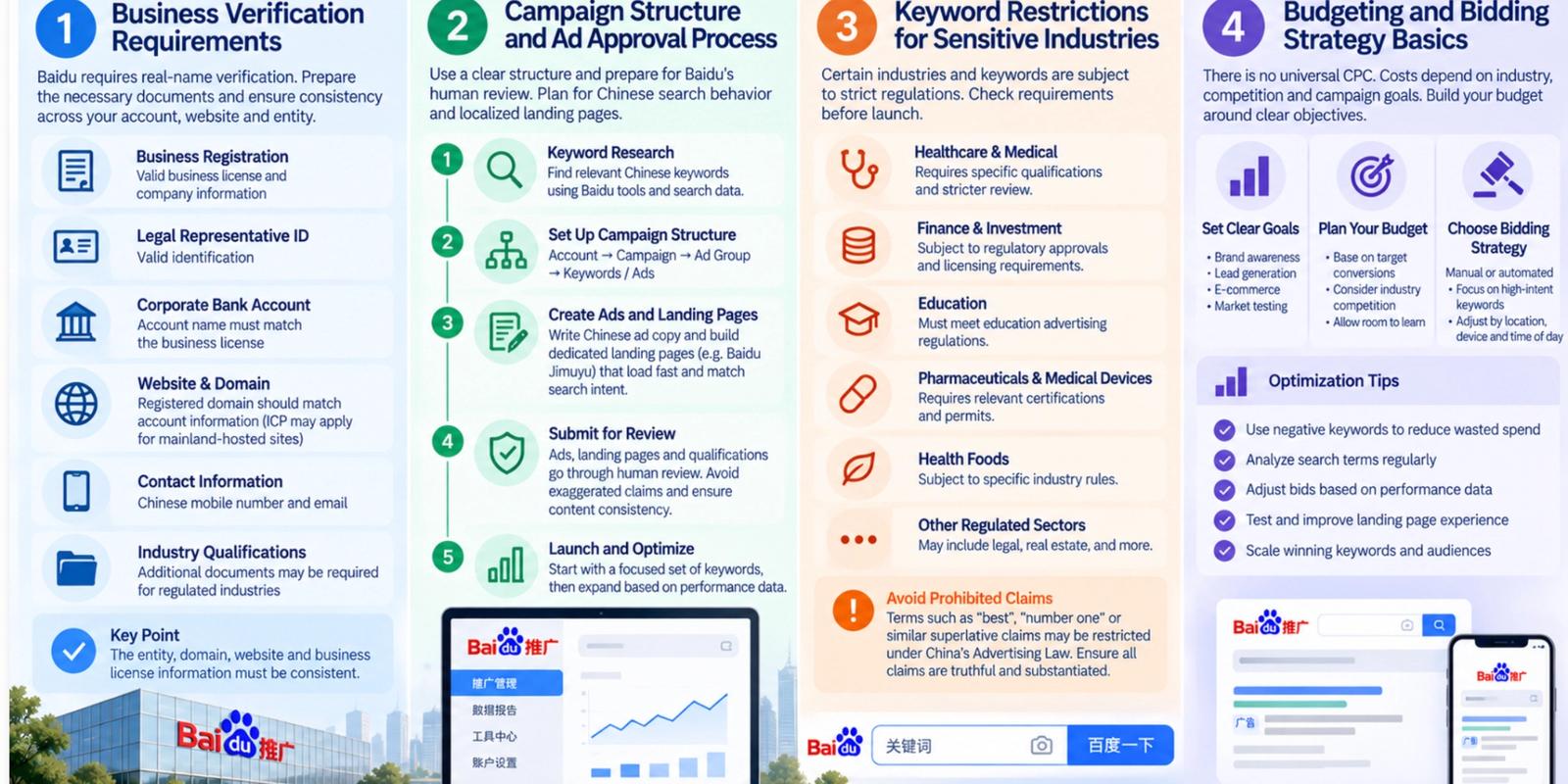
Baidu requires advertisers to complete business and qualification verification before advertising. Foreign companies should confirm their available account-opening route with Baidu or an authorized local service provider before building the campaign.
Baidu's own guidance describes its advertising accounts as operating under a real-name system. The company name, website and URL submitted during registration become associated with the account, and Baidu reviews advertiser qualifications before campaigns are activated.
Baidu also states that advertisers need to register a search-promotion account and make the required prepayment. Once payment has been received and keywords have been added, Baidu says it will generally process the initial qualification review within two working days.
That is the platform-side review target not a guarantee that every foreign advertiser will be live within two days. Additional documentation, industry qualifications and account-opening arrangements can extend the process.
Documents Needed for Foreign Entities
The exact checklist varies by entity, market and industry, so avoid treating one agency's document list as a universal Baidu requirement.
For a mainland entity, advertisers should generally expect to prepare business registration information, company and website details, contact information and any industry-specific qualifications required for the products or services being promoted.
Foreign companies without a mainland entity should first confirm whether they are eligible for an overseas/international account route or whether an authorized partner is required for their jurisdiction and category.
The key principle is consistency.
Baidu's published account rules require the advertiser information and website ownership or operating information to be aligned, and the primary domain registered with the account should correspond to the domain used in keyword landing pages.
If your website is hosted on mainland Chinese servers, separate Chinese internet regulations concerning ICP filing also apply.
This is why account structure should be decided before the landing pages and media plan are finalized—not two days before launch.
Campaign Structure and Ad Approval Process
Baidu’s campaign hierarchy mirrors Google’s (account → campaign → ad group → keywords/ads), so structure discipline transfers. What doesn’t transfer is the workflow:
1. Research keywords in Chinese from scratch.
Never begin with an English keyword spreadsheet and translate it line by line.
Chinese consumers may search using different category terms, problem statements, brand combinations, price-related phrases and review-oriented modifiers. Keyword research should reflect what Chinese users actually type, not how your global team describes the product internally.
Use Baidu's own keyword tools and search data alongside competitor and SERP analysis.
2. Build dedicated Chinese landing pages.
This is one of the biggest performance levers in China search advertising.
A user searching in Chinese should not click an ad only to arrive on an English homepage. Landing pages should be mobile-friendly, fast, relevant to the search intent and consistent with the claims made in the advertisement.
If building standalone campaign pages is difficult, Baidu's Jimuyu provides hosted landing-page tools for Baidu advertising. Baidu describes Jimuyu as supporting multiple advertising scenarios and lead-generation components, including search promotion.
3. Leave time for review.
Advertiser qualifications and advertising content are subject to review. Unsupported claims, prohibited terminology, qualification issues or inconsistencies between an advertisement and its landing page can create delays or rejections.
China's Advertising Law explicitly prohibits certain absolute claims, including terms equivalent to “national-level,” “highest-level” and “best.”
The better approach is often more persuasive anyway: replace “the best industrial solution” with specifications, certifications, measurable performance or other claims you can substantiate.
Write claims you can document.
4. Launch narrowly, then learn.
Start around commercially meaningful search intent rather than buying every possible keyword on day one. Search-term data can then show which queries deserve expansion, which should be excluded and which reveal new content opportunities.
Keyword Restrictions for Sensitive Industries
Baidu advertising eligibility depends not only on the keyword but also on the advertiser, product category and qualifications behind the campaign. Regulated sectors should confirm eligibility before media budgets are committed.
Medical and healthcare advertising is particularly sensitive under Chinese advertising law. Finance and investment products can require additional regulatory qualifications. Education, pharmaceuticals, medical devices, health foods and other regulated categories may also face sector-specific documentation and advertising requirements.
The restrictions don't stop with sensitive industries.
China's Advertising Law applies broadly to commercial advertising. Absolute claims such as “best” and “highest-level” are specifically regulated, while factual claims about performance, sales, market share and other measurable characteristics need appropriate support. China's 2026 guidance further emphasizes that cited sales, market-share and performance information must be truthful, complete and accurate.
If your industry sits in a regulated category, confirm the qualification and advertising requirements before writing the creative.
That conversation is much cheaper before launch than after an entire campaign has been rejected.
Budgeting and Bidding Strategy Basics
There is no reliable universal Baidu CPC benchmark for foreign advertisers. Costs depend heavily on industry, keyword competition, geography, device, audience, landing-page quality and bidding strategy.
This is one area where we would change the original draft rather than repeat attractive but weakly sourced figures.
A keyword costing a few RMB in one category can cost considerably more in competitive B2B, healthcare, legal, education or financial searches. Likewise, the right monthly budget depends on whether the goal is lead generation, e-commerce, brand defense or market testing.
Instead of starting with a generic CPC benchmark, build the budget backwards:
Target conversions × acceptable cost per acquisition = initial performance budget
Then allow enough volume to learn.
A few principles transfer well from global PPC.
Bid for intent, not vanity position. A high-value query deserves more attention than a high-volume informational term that rarely converts.
Use dayparting based on your own data. B2B and consumer search patterns can differ substantially, so don't assume 24/7 bidding is automatically efficient.
Build negative keywords from the beginning. Search-term reviews are one of the fastest ways to remove irrelevant spend and understand how Chinese consumers describe the category.
Don't ignore Bing. StatCounter measured Bing at 18.92% of China's overall search market in August 2026 and 39.4% on desktop. For desktop-heavy B2B audiences in particular, it can be worth evaluating alongside Baidu rather than treating China paid search as a one-engine market.
Measuring Performance and Optimizing Spend
Baidu PPC performance should be measured against business outcomes—not clicks alone. For lead-generation campaigns, qualified leads and customer acquisition matter more than headline CPC.
Baidu's ecosystem includes its own landing-page and conversion tools. Jimuyu, for example, supports lead collection and site analytics, while Baidu's advertising case studies show advertisers using landing-page optimization, conversion components and oCPC bidding together.
For B2B and high-consideration categories, the measurement chain should ideally continue beyond the form submission:
Keyword → Click → Lead → Qualified lead → Opportunity → Revenue
This matters because the cheapest keyword isn't necessarily the most profitable one.
A generic term might generate inexpensive form fills but poor sales leads. A more expensive technical query may produce fewer conversions but much stronger commercial opportunities.
Search-term data has another use: SEO research.
Queries that consistently convert through PPC can inform your Baidu SEO strategy, landing pages, FAQs and editorial content. Paid search effectively becomes a live research environment for understanding Chinese-language demand.
Optimization should therefore be continuous rather than tied to a fixed “month one/month two/month three” formula. Early campaigns need enough time to collect meaningful data, but poor performance shouldn't automatically be excused as a learning phase either.
Watch what the data is telling you: search intent, lead quality, landing-page behavior, conversion cost and most importantly commercial outcomes.
Planning paid search for China? Contact our team for a Baidu readiness assessment, or learn more about our China digital practice.
Frequently Asked Questions
Can a foreign company advertise on Baidu?
Yes, foreign companies can advertise through Baidu, but the account-opening route and required documents depend on the advertiser's entity, jurisdiction, industry and available Baidu or partner arrangements. Foreign companies should verify their route before assuming that a mainland entity is always required.
How much does Baidu PPC cost?
Baidu PPC does not have one meaningful average CPC for every industry. Actual costs vary by keyword competition, category, geography, device, bidding strategy and landing-page performance. Build your budget around conversion targets and acceptable acquisition costs rather than relying on a generic CPC benchmark.
Do I need a Chinese website to run Baidu ads?
A Chinese-language landing experience is strongly recommended for campaigns targeting mainland Chinese users, but the technical setup can vary. A mainland-hosted website requires the relevant ICP filing, while Baidu's Jimuyu can also provide landing pages for advertising scenarios.
How is Baidu PPC different from Google Ads?
Baidu PPC uses familiar paid-search principles but operates within a different advertising, verification and digital ecosystem. Foreign advertisers need to account for Chinese-language keyword behavior, business verification, advertising-law requirements, local landing-page experience and Baidu-specific tools.
How long does Baidu ad account approval take?
Baidu's published guidance says it generally processes the initial qualification review within two working days after the necessary prepayment has been received and keywords have been added. Additional qualification or documentation issues can extend the overall setup process.
Is Baidu still important for search advertising in China in 2026?
Yes. Baidu held 59.26% of China's overall search-engine market in August 2026 according to StatCounter, and Baidu reported 644 million monthly active users for the Baidu App in June 2026. Its position varies by device, however, which is why advertisers should evaluate audience behavior rather than relying only on total market share.